The Manseryeok: Korea's Calendar Behind Saju Readings
What is the Manseryeok? Learn how Korea's ancient astronomical calendar powers every Saju birth chart reading, explained by a real practitioner.
What Is the Manseryeok, and Why Does It Matter for Your Saju Chart?
If you've ever wondered how a Saju practitioner converts your birth date into Four Pillars, the answer is the Manseryeok (만세력). This ancient Korean astronomical calendar is the backbone of every single birth chart reading I do, and honestly, most people have no idea it even exists. Understanding it changes how you see the whole system.
The Manseryeok isn't just a calendar. It's a precisely mapped astronomical reference that assigns specific Heavenly Stems (천간 Cheongan) and Earthly Branches (지지 Jiji) to every year, month, day, and hour going back thousands of years. Without it, there are no Four Pillars. There's no Saju at all.
If you want to see what your own pillars look like, you can grab a free reading and I'll show you exactly what comes up. But first, let me explain the tool that makes it all possible.
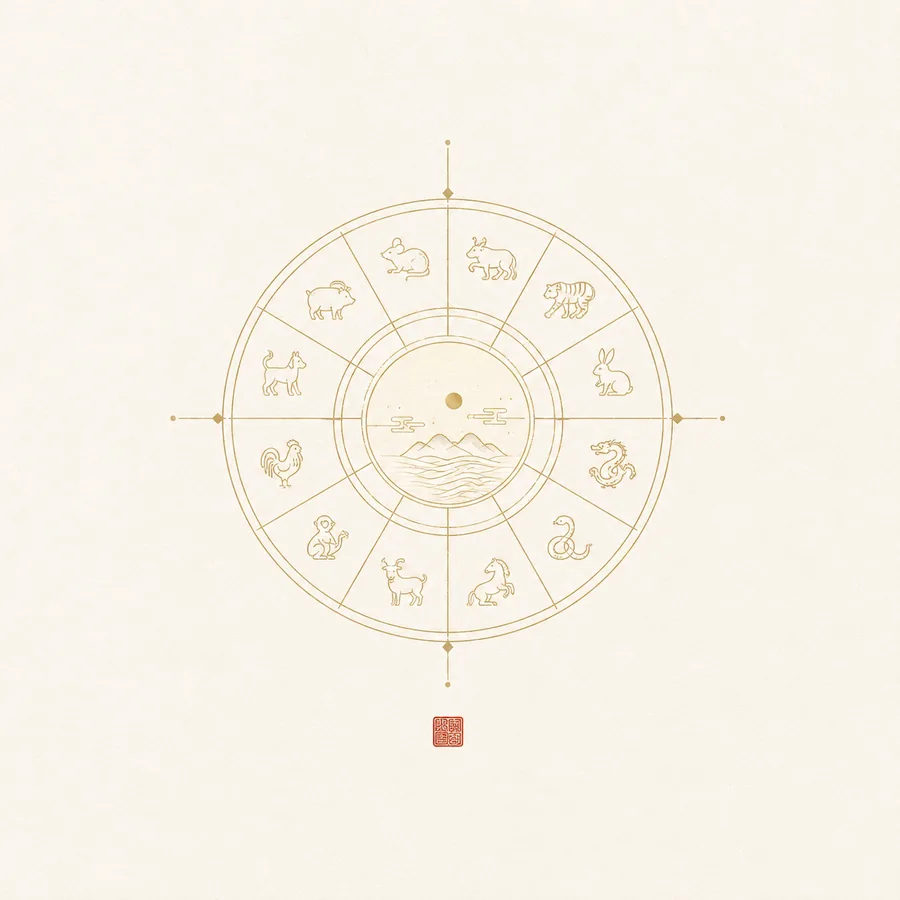
The Manseryeok: More Than Just a Lunar Calendar
A lot of people assume the Manseryeok is simply the Korean lunar calendar. That's a partial truth. It's more accurate to call it a lunisolar calendar, one that tracks both the cycles of the moon and the precise position of the sun throughout the year.
Here's why the distinction matters. The solar component of the Manseryeok is actually what drives the month pillars in Saju. The specific date when the sun crosses each of the 12 zodiac divisions, what we call the "seasonal nodes" or 절기 (Jeolgi), determines when one month pillar ends and another begins. These aren't the 1st of every calendar month. They're specific astronomical events, sometimes falling on the 5th, sometimes the 8th, sometimes later.
I've had clients come to me thinking they were born in a certain month pillar because their birthday is October 10th, only to discover the October seasonal node (한로 Hallo, the Cold Dew) fell on October 8th that year. That two-day difference changed their Month Pillar entirely, which shifted their reading in meaningful ways. This is why serious practitioners never skip the Manseryeok lookup.
How the Manseryeok Assigns the Four Pillars
Let me break this down into something practical.
Every unit of time in the Manseryeok runs on a 60-cycle system called the 60 Gapja (육십갑자 Yukship Gapja). This cycle pairs one of the 10 Heavenly Stems with one of the 12 Earthly Branches in a specific sequence. Since 10 and 12 share a least common multiple of 60, you get exactly 60 unique combinations before the cycle repeats.
The Year Pillar is the most familiar to people. Your birth year in the Manseryeok determines your animal sign and element. But here's what many people miss: the year pillar in Saju doesn't change on January 1st like the Gregorian calendar, or even on the Lunar New Year. It changes on 입춘 (Ipchun), the "Start of Spring" node, which usually falls around February 4th or 5th.
So if you were born on February 2nd, 1990, you might assume you're a Horse. But the Ipchun of 1990 fell on February 4th. That means you're technically still in the 1989 Serpent year by Manseryeok reckoning. This catches people off guard constantly.
The Month Pillar follows the 12 Jeolgi nodes I mentioned earlier. The Day Pillar runs on an uninterrupted 60-day cycle that practitioners look up directly in the Manseryeok tables. And the Hour Pillar is calculated from the Day Stem, dividing the 24-hour cycle into 12 two-hour blocks, each governed by an Earthly Branch.
The Seasonal Nodes (절기 Jeolgi) and Why They're Crucial for Manseryeok Readings
There are 24 Jeolgi in total, split into two types: the "節" (Jeol, major nodes) that actually change the month pillar, and the "中氣" (Junggi, mid-nodes) that mark the energetic midpoint of each month.
For Saju purposes, the 12 Jeol nodes are what matter most. Here's a quick reference:
- 입춘 (Ipchun): Start of Spring, opens Tiger Month (인월 Inwol)
- 경칩 (Gyeongchip): Awakening of Insects, opens Rabbit Month
- 청명 (Cheongmyeong): Clear and Bright, opens Dragon Month
- 입하 (Ipha): Start of Summer, opens Snake Month
- 망종 (Mangjong): Grain in Ear, opens Horse Month
- 소서 (Soseo): Minor Heat, opens Goat Month
- 입추 (Ipchu): Start of Autumn, opens Monkey Month
- 백로 (Baengno): White Dew, opens Rooster Month
- 한로 (Hallo): Cold Dew, opens Dog Month
- 입동 (Ipdong): Start of Winter, opens Pig Month
- 대설 (Daeseol): Major Snow, opens Rat Month
- 소한 (Sohan): Minor Cold, opens Ox Month
Each of these corresponds to a specific solar longitude, calculated astronomically. The Manseryeok encodes all of this so practitioners don't have to recalculate from scratch every time.
Why the Manseryeok Is Different From Western or Chinese Calendars
The Manseryeok has Korean-specific refinements that matter. Korean Saju practitioners historically adapted and localized astronomical records that came in from China, particularly during the Joseon dynasty, but the system was cross-referenced against Korean observational data and codified for Korean practice.
Modern digital Manseryeok tools and apps have made this much more accessible. But in my experience, understanding the underlying logic makes you a better reader. When a client asks why their Grand Fortune (대운 Daeun) starts at age 7 and not age 5, the answer lives in how the Manseryeok calculates the distance from birth to the nearest seasonal node.
The Grand Fortune calculation is actually one of the most powerful applications of the Manseryeok. The number of days between your birthday and the next (or previous) Jeolgi node is counted, and divided by 3 to give your fortune starting age. Each 10-year Grand Fortune period then runs on specific stems and branches pulled directly from the Manseryeok sequence. This is the most important timing mechanism in all of Saju, and it only works because of the Manseryeok's precise astronomical mapping.
Want to go deeper on how to read and study these cycles yourself? The free Saju ebook covers the foundational mechanics in a way that's actually approachable for beginners.
Common Manseryeok Mistakes That Affect Your Reading
I want to be direct about this because I've corrected so many readings over the years.
Using the wrong year start. Thinking your year pillar is based on January 1st or the Lunar New Year. It's Ipchun. Always.
Ignoring the exact time of the Jeolgi. The seasonal node doesn't just happen "on" a date. It happens at a specific hour. If you were born on February 4th at 9am and Ipchun that year occurred at 11am, you're still in the previous year's pillar. The hour matters.
Skipping the hour pillar. Some people get readings without their birth time and just work with three pillars. That's fine as an approximation, but the hour pillar is where a lot of nuance lives. It reflects your inner world and late-life energy. If you can find your birth time, use it.
Relying on apps without verification. Most Manseryeok apps are accurate, but I've seen errors, especially around borderline dates near seasonal nodes. When a reading feels off, double-check the node timing.
Frequently Asked Questions
What does Manseryeok mean in Korean?
Manseryeok (만세력) literally translates to "ten thousand year calendar." The characters break down as 만 (man, ten thousand), 세 (se, years/age), and 력 (ryeok, calendar or almanac). It's called this because the tables traditionally span thousands of years of astronomical data, allowing practitioners to look up any date in recorded history.
Is the Manseryeok the same as the Chinese Tung Shing calendar?
They share the same 60 Gapja root system, but they're not identical. The Manseryeok is the Korean adaptation and has been maintained with Korean-specific refinements. Some practitioners also use slightly different conventions, particularly around regional time zone standards, which affects calculations for people born before 1908 when Korea had its own local solar time.
Do I need the Manseryeok to understand my Saju chart?
You don't need to use the Manseryeok directly as a reader, but the practitioner or software interpreting your chart absolutely must use it. If someone gives you your Four Pillars without accounting for the Jeolgi cutoff dates, there's a meaningful chance your Month Pillar (and potentially your Year Pillar) is wrong.
How do the Jeolgi nodes affect the Five Elements in a reading?
Each month governed by a Jeolgi node corresponds to a season and element. Wood months (Spring) strengthen Wood energy in the chart. Fire months (Summer) amplify Fire. This affects how your Day Master (일간 Ilgan) interacts with its environment and whether your chart leans balanced or excessive in a given element. The Manseryeok is essentially the map that tells us which elemental weather you were born into.
The Manseryeok is one of those things that sits completely in the background of a reading, and yet everything depends on it. Getting your pillars right is the foundation. After that, the real interpretation begins, the Five Elements, your Day Master's strength, your Useful God (용신 Yongsin), your Grand Fortune cycles. All of it builds on that initial calculation.
If you're ready to see your own chart built correctly from the Manseryeok up, with full interpretation of your elements, Day Master, and current fortune cycle, I'd love to put it together for you.
Discover Your Destiny
Curious about your own chart?
Get a free mini reading, then unlock your full Four Pillars report from a certified Saju master.