Why Gen Z Is Ditching MBTI for Saju (And What Your Day Master Says About You)
Gen Z is trading personality tests for Saju Four Pillars. Learn what your Day Master reveals about your core energy and why Korean astrology beats MBTI in 2026.

You've taken the MBTI test five times and gotten three different results. Your friends still argue whether you're INFP or INFJ. Meanwhile, a whole generation is quietly logging off the personality-test industrial complex and logging into something way older, and weirdly more accurate. Welcome to Saju, the Korean Four Pillars system that's become Gen Z's spiritual self-care obsession in 2026.
The MBTI Fatigue Is Real (And Gen Z Knows It)
Let's be honest: MBTI was fun until everyone became an armchair psychologist. Your entire feed is "ENFP things" memes, your workplace made you take it twice, and you're tired of being put in a box based on how you answered 60 questions on a random Tuesday. The 16-personality framework worked when we needed quick labels, but Gen Z craves depth. We want systems that acknowledge complexity, contradiction, and growth.
Enter Saju. Unlike MBTI, which locks you into four letters for life, the Four Pillars system reads your birth chart as a living ecosystem. Your Day Master (일간), the core element representing you, interacts with the other elements in your chart, creating a dynamic portrait that shifts with time. You're not frozen at age 16 when you first took that test. You're a Wood Day Master navigating a Metal year, and that tension? It's teaching you something.
The numbers back this up. A 2026 Barna study found 38% of Gen Z expect a major spiritual awakening this year. We're not talking church pews, we're talking tarot apps, manifestation journals, and yes, Korean Four Pillars readings. Saju fits perfectly into this spiritual revival because it's structured (we love frameworks), ancient (we trust old wisdom), and personal (no two charts are identical).

What Actually Is Saju? (The 60-Second Breakdown)
Saju translates to "Four Pillars" (사주명리학), and it's a 1,200-year-old Korean system rooted in Chinese metaphysics. Here's the deal: your birth date and time create four pillars, Year, Month, Day, Hour, each made of a Heavenly Stem (천간) and Earthly Branch (지지). Together, these eight characters map your energetic blueprint.
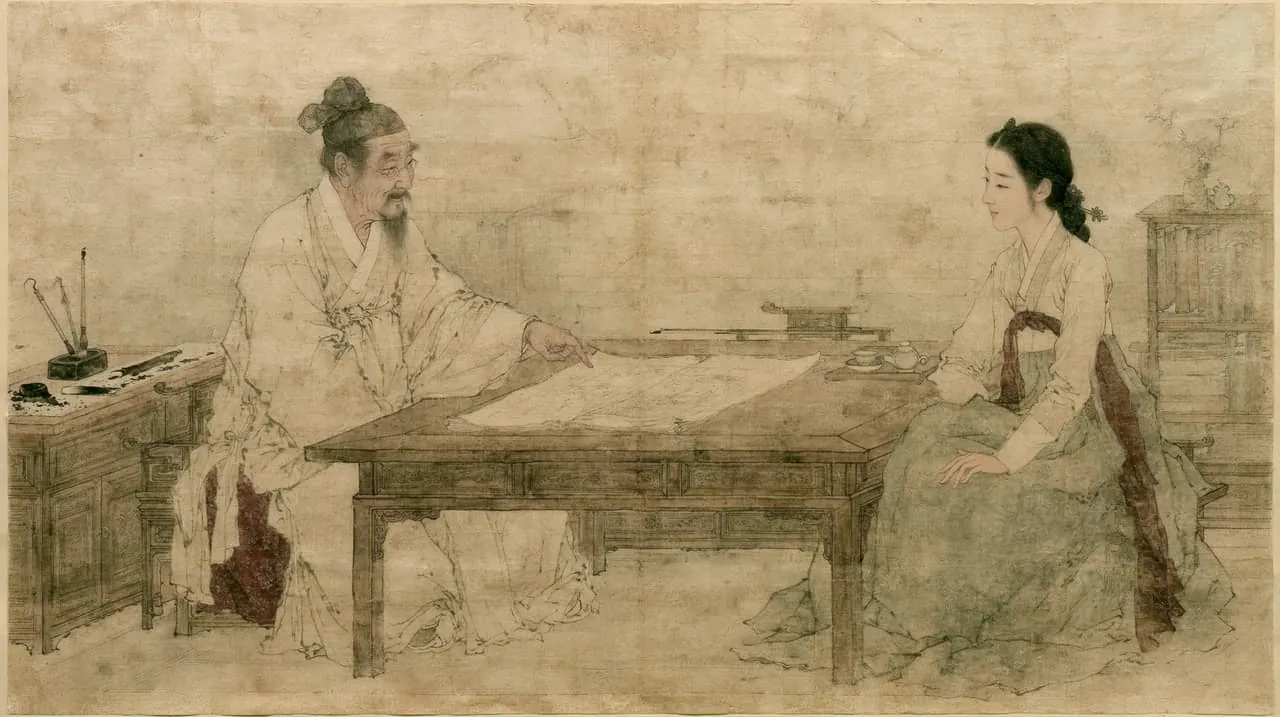
Think of it like this: if Western astrology uses planets and zodiac signs, Saju uses Five Elements (오행), Wood, Fire, Earth, Metal, Water, and their interactions. Your chart shows which elements you have, which you're missing, and how they balance (or clash). The Day Pillar is you, your Day Master element defines your core personality, your default mode, your main character energy.
Here's what Saju is NOT:
- It's not your sun sign, moon sign, or rising. Totally different system.
- It's not a horoscope that tells you "you will meet someone tall on Thursday."
- It's not a personality quiz. Your chart is fixed at birth; you don't retake it.
- It's not fortune-telling. Saju illuminates patterns and tendencies, it doesn't dictate fate.
Saju is closer to reading your energetic weather forecast for the next 80 years, complete with storm warnings and sunny intervals.
Your Day Master: The Main Character of Your Chart
If your Saju chart is a Netflix series, your Day Master is the protagonist. This single Heavenly Stem in your Day Pillar represents you, your essence, your vibe, your core operating system. There are ten possible Day Masters (five elements × two polarities: yang and yin), and each has a completely different energy signature.
Let's break down the five elements:
| Day Master Element | Core Energy | Strengths | Growth Edges |
|---|---|---|---|
| Wood (甲/乙) | Growth, creativity, vision | Idealistic, adaptable, innovative | Can be stubborn, scattered, impatient |
| Fire (丙/丁) | Passion, charisma, action | Magnetic, enthusiastic, bold | Burns out fast, impulsive, needs validation |
| Earth (戊/己) | Stability, nurture, trust | Loyal, grounded, practical | Overthinks, people-pleases, resists change |
| Metal (庚/辛) | Precision, justice, clarity | Disciplined, principled, sharp | Rigid, critical, struggles with mess |
| Water (壬/癸) | Flow, intuition, depth | Wise, empathetic, adaptable | Moody, secretive, avoids conflict |
Your Day Master isn't a vibe check, it's a blueprint. A Yang Wood (甲) Day Master is a towering oak: ambitious, confident, grows toward the light. A Yin Wood (乙) Day Master is bamboo: flexible, social, bends but doesn't break. Same element, totally different expressions.
Here's where it gets wild: your Day Master interacts with the other elements in your chart. A Fire Day Master born in a Water-heavy year? That's steam energy, intense, transformative, sometimes volatile. A Metal Day Master with tons of Earth support? That's gold being refined, slow, deliberate, valuable.
Why Gen Z Vibes With Saju (Beyond the Aesthetic)
Sure, Saju has that moody, mystical aesthetic we love. The Hanja characters look incredible on an Instagram story. But Gen Z isn't just here for the vibes, we're here because Saju works in ways MBTI doesn't.
1. It's dynamic, not static.
MBTI says you're an ENFP forever. Saju says you're a Wood Day Master entering a Metal Luck Pillar (대운), which means the next ten years will challenge your flexibility and teach you boundaries. You're not changing, you're evolving through cycles. That resonates with a generation that's lived through a pandemic, a recession, and three different aesthetics since 2020.
2. It's spiritual, not corporate.
MBTI was literally designed for workplace efficiency. Saju comes from Taoist philosophy and Korean shamanic traditions. It's not trying to make you a better employee, it's trying to help you understand your soul's path. Gen Z spirituality in 2026 is less about organized religion and more about personal practice. Saju fits that vibe perfectly.
3. It's specific without being limiting.
Your Day Master gives you a core identity, but your full chart has eight characters, Ten Gods (십신), annual cycles, and Luck Pillars. You're not one of 16 types, you're one of millions of possible combinations. That granularity matters when you've spent your whole life being told you're "just another Millennial" (we're not even Millennials, but okay).
4. It connects you to something ancient.
We're the generation that grew up on Wikipedia and AI chatbots. There's something grounding about consulting a system that Korean scholars used in the Joseon Dynasty. Saju isn't trying to disrupt anything, it's been here, steady, for over a millennium. In a world where everything feels temporary, that permanence hits different.
How Saju Works in Real Life (Not Just Theory)
Let's get practical. Say you're a Water Day Master (Yin Water, 癸, specifically, think mist, rain, the ocean's depths). Your chart shows you're intuitive, emotionally intelligent, and drawn to creative or healing work. Cool. But here's what Saju adds that MBTI can't:
- Your current Luck Pillar (ten-year cycle) is Fire. Water and Fire clash, you might feel drained, forced into the spotlight, or pressured to perform. Saju doesn't say "this is bad." It says "this is growth. Fire is teaching Water to boil, to transform, to rise as steam."
- Your Year Pillar (representing 2026) is Earth. Earth muddies Water but also gives it shape (think riverbanks). This year asks you to build structure around your flow. Start that Substack. Finish that project. Give your creativity a container.
- Your Ten Gods show you have strong "Eating God" energy (식신), you express yourself through creation, food, art, pleasure. You're not just a Water type; you're a Water type who needs to make things or you'll spiral.
See the difference? MBTI says "you're introverted." Saju says "you're a Water Day Master in a Fire decade with Earth energy grounding you this year, here's how to navigate that." One is a label. The other is a map.
The 24 Solar Terms: Saju's Secret Timing System
Here's something most beginner Saju content skips: the 24 Solar Terms (절기). These aren't random, they're the astronomical checkpoints that determine when your Month Pillar changes. Unlike Western astrology (which uses equinoxes and solstices), Saju divides the year into 24 fifteen-day segments based on the sun's position.
Why does this matter? Because your Month Pillar represents your prime-of-life energy (ages 17-48ish), and it's calculated using these solar terms, not the Gregorian calendar. If you were born on February 3rd, your Month Pillar might be late Ox (丑) or early Tiger (寅) depending on the exact hour the solar term shifted that year.
This precision is why Saju readers ask for your birth time down to the minute. Your Hour Pillar determines your late-life trajectory and your relationship with legacy. Born at 11:58 PM vs. 12:02 AM? Different Hour Pillar, different destiny flavor.
Gen Z loves this level of detail. We're the generation that tracks our screen time, our macros, our sleep cycles. Saju's granularity feels like the spiritual equivalent of a Whoop band, data-driven self-knowledge.
What Your Day Master Reveals (That MBTI Never Could)
Let's go deeper on Day Masters with real examples:
Yang Metal (庚) Day Master:
You're a sword. You're here to cut through bullshit, establish justice, and refine chaos into order. You have opinions. You can't stand inefficiency. People either love your directness or find you intimidating (you don't care which). Your challenge? Learning that not everything needs to be fixed or sharpened. Sometimes the sword rests.
Yin Fire (丁) Day Master:
You're a candle flame. You light up rooms, you're everyone's therapist, you thrive on one-on-one connection. But you also burn out if you're not careful. You need people to see you, to witness your warmth, but you give so much that you forget to refuel. Your growth edge is learning that you can't pour from an empty candle.
Yang Earth (戊) Day Master:
You're a mountain. Solid. Dependable. Everyone builds their life on your stability, and you're fine with that, until you're not. You have strong boundaries once you finally set them, but you take a long time to move. Your lesson is that mountains can erode if they don't honor their own limits. You're allowed to say no.
Yin Wood (乙) Day Master:
You're bamboo in a windstorm. Flexible, social, adaptable to the point where people underestimate you. But bamboo is strong, it bends, but it doesn't break, and it grows in communities. You thrive in collaboration, but you struggle with isolation. Your challenge is learning that flexibility isn't the same as people-pleasing. You can bend and still have roots.
Yang Water (壬) Day Master:
You're the ocean. Deep, powerful, a little scary if someone doesn't know how to swim in your energy. You hold everything, secrets, emotions, ancient wisdom, and you rarely show your full depth. People see the surface and think they know you. They don't. Your growth edge is learning that you don't have to carry everyone's weight. The ocean is allowed to have tides.
Notice how none of these are prescriptive? Saju doesn't say "you will become a lawyer" or "you'll meet your soulmate in June." It says "you have Metal energy, which means you value precision, here's how that shows up, here's where it serves you, here's where it doesn't." You're still the author. Saju just hands you the themes.
Why Saju Isn't Fortune-Telling (And Why That's the Point)
Let's clear this up: Saju doesn't predict your future. It maps your energetic landscape and shows you the weather patterns ahead. Think of it like this, if you're a Fire Day Master and you're entering a Water Luck Pillar, Saju doesn't say "bad things will happen." It says "Water will test Fire. You might feel dampened, restricted, or forced to transform. But Fire needs Water sometimes, it creates steam, it refines, it teaches moderation."
You still choose how you respond. You still have agency. Saju isn't handing you a script, it's handing you a topographic map before a hike. You can see the steep parts, the valleys, the overlooks. What you do with that information is entirely up to you.
This is why Gen Z vibes with Saju in 2026. We're exhausted by deterministic thinking ("the algorithm says you'll like this"). We want tools, not answers. We want frameworks that honor our complexity. Saju delivers.
Ready to Find Your Day Master?
You've read this far, which means you're curious. Maybe you're tired of personality tests that box you in. Maybe you're part of the 38% of Gen Z expecting a spiritual awakening this year. Maybe you just want to know if you're a Metal Day Master because that sword energy is calling.
Here's the thing: your Day Master is waiting in your birth chart. It's been there since the minute you were born, and it's not going anywhere. The question is whether you're ready to meet it.
Try a Free Mini Reading and discover your Day Master in under two minutes. No signup walls, no upsells, just you, your birth data, and the element that's been running your life this whole time. See what a thousand years of Korean wisdom has to say about your main character energy.
Because here's what we know: MBTI told you what you are. Saju shows you who you are, and who you're becoming.
Glossary
Day Master (일간): The Heavenly Stem of your Day Pillar; represents your core identity and elemental essence. This is you in the Saju system.
Four Pillars (사주): The four columns (Year, Month, Day, Hour) that make up your birth chart, each containing a Heavenly Stem and Earthly Branch.
Five Elements (오행): Wood, Fire, Earth, Metal, and Water, the fundamental energies in Saju that interact through cycles of generation and control.
Heavenly Stems (천간): The ten celestial elements (five elements × yang/yin polarity) that form the top half of each Pillar.
Luck Pillars (대운): Ten-year cycles that shift throughout your life, bringing new elemental influences and themes. Your chart is fixed, but Luck Pillars show how you move through time.
Ten Gods (십신): Ten archetypal relationships between your Day Master and other elements in your chart (e.g., Eating God, Hurting Officer, Indirect Wealth). They reveal how you express power, creativity, relationships, and resources.
24 Solar Terms (절기): Astronomical checkpoints dividing the year into 24 fifteen-day periods, used to calculate your Month Pillar with precision. Based on the sun's longitude, not the Gregorian calendar.
Discover Your Destiny
Curious about your own chart?
Get a free mini reading, then unlock your full Four Pillars report from a certified Saju master.