How the Month Branch Decides Which Element Rules a Chart
The month branch is the most powerful position in Korean Saju. Learn how it determines which element dominates your Four Pillars reading.

How the Month Branch Decides Which Element Rules a Chart
The month branch is, hands down, the most influential single character in your entire Saju chart. Not the Day Master. Not the year. The month branch (월지, Wolji) sets the seasonal tone that every other element in your Four Pillars has to respond to. If you've ever wondered why two people born in the same year with the same Day Master can have wildly different readings, this is the answer. The month branch decides which element is in command of the environment your chart lives in.
Before we get into the mechanics, if you want to see your own month branch and how it shapes your chart, you can start with a free reading to get your Four Pillars laid out.
Most people new to Korean astrology fixate on the Day Master (일간, Ilgan) because it represents your core identity. That's fair. But here's the thing: your Day Master is who you are. The month branch is the world you were born into. And the world you're born into has a massive say in whether your identity thrives or struggles.
Why the Month Branch Holds So Much Power
In Saju (사주), each of the Four Pillars has a Heavenly Stem on top and an Earthly Branch on the bottom. The Earthly Branches carry hidden stems inside them, and they're deeply tied to seasonal energy. The month branch specifically represents the season you were born in, and seasons are the single strongest expression of elemental force in nature.
Think about it in real terms. A tree (Wood element) planted in spring has the full force of the season behind it. That same tree trying to grow in autumn, when Metal energy is condensing and cutting, faces resistance at every turn. The tree is still a tree. But its environment completely changes what's possible.
That's what the month branch does to your chart. It floods the reading with one dominant elemental energy.
The Seasonal Framework: Which Element Rules When
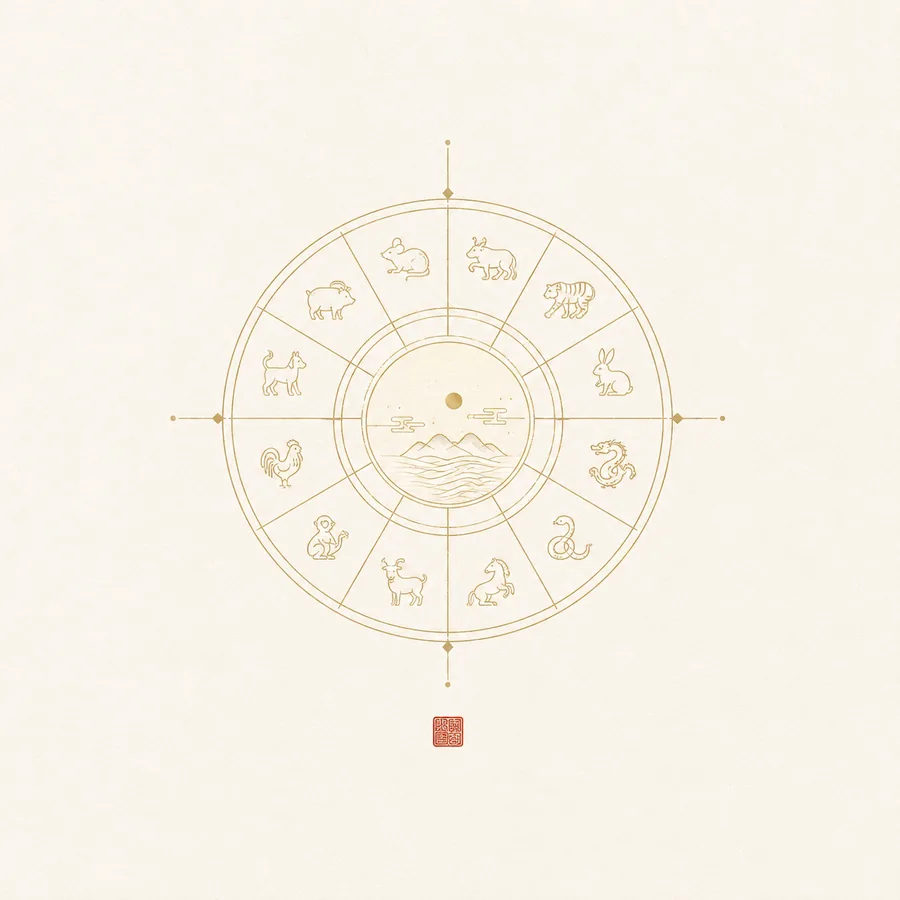
Here's the breakdown of how the twelve Earthly Branches map to seasons and their ruling elements:
Spring (Wood rules):
- 寅 (In/Tiger), Early Spring
- 卯 (Myo/Rabbit), Peak Spring
- 辰 (Jin/Dragon), Late Spring (Earth transition)
Summer (Fire rules):
- 巳 (Sa/Snake), Early Summer
- 午 (O/Horse), Peak Summer
- 未 (Mi/Goat), Late Summer (Earth transition)
Autumn (Metal rules):
- 申 (Sin/Monkey), Early Autumn
- 酉 (Yu/Rooster), Peak Autumn
- 戌 (Sul/Dog), Late Autumn (Earth transition)
Winter (Water rules):
- 亥 (Hae/Pig), Early Winter
- 子 (Ja/Rat), Peak Winter
- 丑 (Chuk/Ox), Late Winter (Earth transition)
Notice something? Every season has a transitional Earth month at the end (Dragon, Goat, Dog, Ox). These are the four Earth branches, and they create a brief pause before the next season takes over. Earth's movement is centering and settling. It's the buffer zone.
When someone is born in a peak month like Rabbit (卯) or Horse (午), the seasonal element is at maximum intensity. Born in a transitional Earth month? The energy is more mixed, more ambiguous. I'll get into why that matters in a second.
How the Month Branch Interacts with Your Day Master
So here's where it gets personal. Your Day Master is one of the Five Elements (오행, Ohaeng): Wood, Fire, Earth, Metal, or Water. The month branch pours a specific element into your chart's environment. The relationship between these two determines a lot about your natural advantages and struggles.
Same element as the month branch: Your Day Master is strong. Say someone has a Wood Day Master born in the Rabbit month. That's Wood on Wood. The season feeds the identity directly. These charts tend to have a confident, sometimes stubborn quality. The danger? Too much of the same element with nothing to balance it.
Produced by the month branch: This is comfortable. A Fire Day Master born in spring (Wood month) gets fed naturally because Wood produces Fire in the productive cycle (상생). The season is kindling for the identity. These people often feel like things come to them without excessive struggle, at least in the areas the Day Master governs.
Controlled by the month branch: This is where tension lives. A Wood Day Master born in autumn (Metal month) faces the controlling cycle (상극) head-on. Metal cuts Wood. The seasonal energy is actively working against the Day Master's natural expression. Honestly, this is one of the configurations I spend the most time on in readings because the person often feels like they're swimming upstream without understanding why.
Draining the month branch: If your Day Master produces the month branch element (like Fire producing Earth, then being born in an Earth transition month), there's a subtle drain. You're constantly giving energy to the environment around you. Provider types. Caretakers. People who feel tired in ways they can't explain.
Controlling the month branch: Your Day Master controls the seasonal element. A Metal Day Master born in a Wood month, for instance. This can look like natural authority, but controlling costs the controller energy. It's not free. There's always a price.
The Month Branch and the Useful God (용신, Yongsin)
This is where advanced Saju practice really kicks in. The Useful God, or Yongsin, is the single element your chart needs most for balance. And guess what's the primary factor in determining it? The month branch.
Here's how it works in practice. If the month branch makes your Day Master excessively strong (same element or element that produces it), your Yongsin will typically be something that controls or drains your Day Master. The chart needs a counterweight.
If the month branch weakens your Day Master (controlling or draining it), your Yongsin will usually be something that supports or strengthens it.
Take a hypothetical chart: a Water Day Master born in the Horse month (午), which is peak Fire. Water controls Fire, yes, but being born in peak summer means the Fire energy is overwhelmingly strong. One Water stem sitting in a sea of seasonal Fire doesn't have the strength to control anything. In this case, the chart likely needs Metal (which produces Water) as the Yongsin to give that Water Day Master some backup.
The month branch sets the battlefield. The Yongsin is the strategy for surviving it.
If you want to go deeper into how concepts like the Yongsin work, the free Saju ebook is a solid starting point for building that foundation.
Peak Months vs. Transitional Earth Months
I mentioned this earlier, and it deserves its own section because people born in transitional Earth months (Dragon 辰, Goat 未, Dog 戌, Ox 丑) often get confused readings from practitioners who oversimplify.
These months are tricky. The Earth element is present, but the residual energy of the previous season's element is still lingering, and the hidden stems inside the branch carry multiple elements. The Dragon branch, for example, sits at the tail end of spring. It contains Earth as its main qi, but also residual Wood and some Water in its hidden stems.
So when someone asks "which element rules my chart?" and they were born in a transitional month, the answer is genuinely more complicated. The month branch still holds enormous weight, but the ruling element isn't as clean or singular. The chart becomes more nuanced. More layered. Sometimes harder to read, but also more interesting.
People born in these months often have an adaptable quality. Earth's nature is centering and stabilizing, so there's often a grounding influence even when the rest of the chart is chaotic. But they can also struggle with the Earth emotion of worry, especially when life demands they pick a direction and commit.
How Grand Fortune Periods Shift the Ruling Energy
Here's something that throws people off: the element that rules your chart isn't permanently fixed. The month branch sets your natal dominant energy, but Grand Fortune periods (대운, Daeun) cycle through different elemental phases every ten years. When a Daeun period brings in a new element that's stronger than or conflicts with your month branch energy, the entire dynamic shifts.
Say someone with a strong Metal month branch enters a Fire Daeun. Fire melts Metal. Suddenly, the element that ruled their chart from birth is under pressure. The skills and strengths that came naturally might feel less reliable. New challenges emerge. But also, new opportunities if the chart was previously too Metal-heavy and needed Fire for balance.
This is why Saju isn't a static snapshot. The month branch sets the default. Time changes the context.
Why This Matters for Real Life Decisions
Understanding which element rules your chart through the month branch has practical applications. Career choices, relationship dynamics, even when to push hard versus when to rest. These all connect back to whether your current environment supports or fights against your chart's elemental landscape.
A Metal Day Master in a Metal month (very strong Metal) thrives in specialist roles: precision work, quality control, deep expertise. Put that same person in a high-volume, chaotic startup environment and they'll burn out fast. Not because they're weak, but because the environment doesn't match the energy their chart was built around.
For relationship dynamics, the month branch plays a role too. When two people's month branches create a harmonious elemental flow, there's a natural ease. When they clash, there's friction that both people feel but might not be able to name. If you're curious about how this plays out romantically, a Saju love reading can map that compatibility in detail.
Frequently Asked Questions
Is the month branch more important than the Day Master in Saju?
They serve different functions. The Day Master is your core identity, who you fundamentally are. The month branch is the environment that identity operates in. Neither is "more important" in isolation, but the month branch has the strongest influence on determining chart strength and the Useful God (용신). In terms of raw elemental power, the month branch usually wins.
What if my Day Master and month branch are the same element?
This creates a strong Day Master. You'll likely have natural confidence and resilience in the areas that element governs. But too much of the same element without balance can create rigidity or excess. Your Yongsin will typically be an element that controls or channels that strength productively.
Can the month branch's influence change over time?
Yes. While your natal month branch never changes, Grand Fortune periods (대운, Daeun) introduce new elemental energies every ten years. These can support, weaken, or transform the month branch's influence. Annual Fortune (연운, Yeonun) does the same on a yearly scale, though with less intensity. Your chart is always in conversation with time.
How do I find out which element my month branch carries?
Your month branch is determined by your birth month in the lunar calendar, mapped to one of the twelve Earthly Branches. Each branch carries a primary element plus hidden stems. A proper Saju chart calculation will show you exactly which branch and elements are in your month pillar. Online tools can generate this, but interpretation is where the real insight lives.
The month branch is the engine room of your Saju chart. Everything else, your Day Master, your Ten Gods (십신), your luck periods, all of it responds to the seasonal energy that was locked in place the moment you were born. Understanding this one position transforms how you read everything else.
Ready to see exactly how the month branch shapes your chart?
Discover Your Destiny
Curious about your own chart?
Get a free mini reading, then unlock your full Four Pillars report from a certified Saju master.