Korean 60th Birthday Meaning: The Year Your Birth Chart Comes Back
Hwangap, the Korean 60th birthday, is the year your saju year and month pillars repeat. Find your return year and the day your full chart comes back.
Most people know hwangap as a party. In Korea the 60th birthday has long been one of the biggest family occasions of a lifetime. What fewer people know is why the number is 60 and not 50 or 70. The answer sits inside the calendar that saju is built on, and you can check it against your own birth date in a few minutes.
I have read charts for more than fifteen years, and the hwangap year is one of the few moments when the calendar hands everyone the same event: a pillar from the birth chart returns, character for character. If you have never seen your own four pillars, run your birth date through the free saju reading first so you have the eight characters in front of you.
Here is what actually comes back at sixty, what does not, and how to find the single day, and the two-hour window inside it, when a whole birth chart repeats.
Why Korea Counts to Sixty
Hwangap (환갑, 還甲) means "the return of gap." Gap (甲) is the first of the ten Heavenly Stems, and the word points to the first pair of the cycle, gapja (甲子), coming around again. Koreans also say hoegap (회갑, 回甲), which means the same thing.
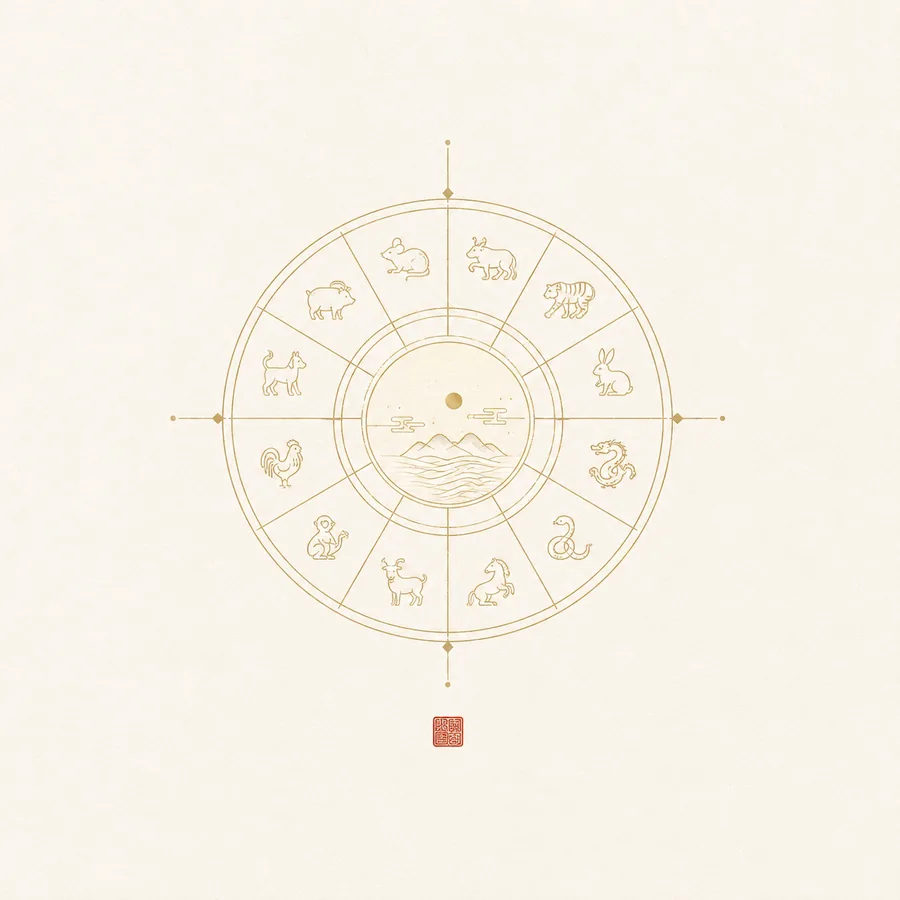
The cycle itself is simple. There are ten Heavenly Stems and twelve Earthly Branches, and they advance together one step at a time: 甲子, 乙丑, 丙寅, and so on. Because 10 and 12 share a factor of 2, a yang stem only ever meets a yang branch and a yin stem only ever meets a yin branch. That gives 60 pairs instead of 120, and after the 60th pair (癸亥) the count starts over at 甲子. Koreans call the full set yuksip gapja (육십갑자). If you want the building blocks first, the guide to the 22 Heavenly Stems and Earthly Branches walks through each one.
Saju assigns one of these 60 pairs to every year, month, day and two-hour block. Sixty years after your birth year, its exact pair returns: the first time in your life the year wears the same name as the year you arrived.
Sixty or sixty-one?
Traditionally hwangap was held in the year a person turned 61 by the old Korean age count, where you are one at birth. In international age that is the 60th birthday. Korea switched its legal age system to international age in June 2023, so most families today simply say 60. Either way it is the same calendar year. The year after, called jingap (진갑, 進甲), was traditionally marked too, though more quietly.
What Actually Repeats at Sixty
This is where the saju view gets more interesting than the party.
The year pillar repeats exactly
The year pillar runs on a plain formula: subtract 4 from the year and divide by 60, and the remainder points to the pair. 1966 gives 丙午, Byeong Horse, a Yang Fire Horse year. 2026 gives 丙午 again. Anyone whose saju year is 1966 is living their hwangap year right now.
One catch: the saju year starts at Ipchun (입춘), the solar term that falls around 4 February, not on 1 January and not on Lunar New Year. A chart with a birth date of 20 January 1966 belongs to the previous saju year, 乙巳 (Eul Snake), so its year pillar returned in 2025. The post on why Lunar New Year is the wrong saju boundary covers this in detail.
The month pillar repeats too
Most people miss this one. In saju the stem of each month is set by the stem of the year. A Byeong year always opens its spring with 庚寅 (Gyeong Tiger) and then runs through the same twelve month pillars in the same order. Since the hwangap year has the same stem as the birth year, every month of that year carries exactly the pillar it carried when you were born.
Month boundaries follow the solar terms, as explained in how solar terms decide your month pillar. So your birth month pillar returns for roughly thirty days, starting on the same solar term that opened your birth month. Take a chart born on 22 March 1966. That month began at Gyeongchip (경칩) in early March and carries 辛卯 (Sin Rabbit). In 2026 the same 辛卯 month runs from Gyeongchip in early March to Cheongmyeong (청명) in early April.
The day pillar does not line up with the date
Days run on the same sixty-step cycle without a break, so your day pillar comes back every 60 days. It does not usually fall on your birthday, though. Sixty calendar years contain 21,915 days, because for anyone born between 1901 and 2039 exactly 15 of those years are leap years. 21,915 divided by 60 leaves a remainder of 15. So on your 60th birthday, the day pillar sits 15 steps past the one you were born on.
That gives a neat rule: around your 60th birthday, your birth day pillar appears 15 days before the birthday date, and again 45 days after it.
I check this with the formula I use for every chart, (Julian Day Number + 49) mod 60. 22 March 1966 is a 庚辰 day, Gyeong Dragon. Fifteen days before 22 March 2026 is 7 March 2026, and that date is also a 庚辰 day.
The hour pillar follows the day
The hour stem is set by the day stem, the same way the month stem is set by the year stem. So on any day that repeats your day pillar, the two-hour block you were born in carries your exact hour pillar as well. The details are in how the hour pillar is calculated.
Find Your Full-Chart Return Day: A Four-Step Check
Put those rules together and there can be one day around your 60th birthday when the year, month, day and hour pillars all match the birth chart, eight characters out of eight, for about two hours. Whether that day exists for you depends on where your birthday falls inside its solar month.
- Confirm your saju birth year. If you were born between 1 January and early February, check whether the birth came before Ipchun. Your hwangap year is your saju year plus 60.
- Find your solar month. Note which solar term opened your birth month and how many days after it you were born. The 24 solar terms table lists them.
- Count back 15 days. Take your 60th birthday date and subtract 15 days. That date carries your birth day pillar.
- Check the month. If the date from step 3 still falls on or after the solar term that opened your birth month, all four pillars return that day during your birth hour. If it falls before, the day pillar lands in the previous month and the full match does not happen.
In practice, charts born about 15 or more days after their month's solar term get a full-chart return day, and charts born in the first half of their solar month do not. Compare two hypothetical charts from the same month. A chart born on 22 March 1966 (庚辰 day): 7 March 2026 comes after Gyeongchip, so all eight characters repeat that day. A chart born on 15 March 1966 (癸酉 day): fifteen days back is 28 February 2026, still inside the Tiger month, and the next 癸酉 day is 29 April 2026, already in the Dragon month. No full return for that chart.
Solar terms shift by about a day between years, so if your result lands within a day of one, check its exact time.
Is the full return day a major event? Not by itself. It is simply one of the clearest ways to see that a saju chart is a timestamp in a repeating calendar, not a fixed label.
How a Saju Reader Looks at the Hwangap Year
The return of a natal pillar in the timeline has a name in classical saju: bokeum (복음, 伏吟). The old texts treat it as a doubling, not a fresh start. Whatever the year pillar already does in the chart, the hwangap year does more loudly.
That is why the same year can feel completely different for two people born in it. Using the 1966 Fire Horse year pillar as the example, I ask three questions.
Is the returning element helpful to the chart?
If Fire is the chart's useful element, a second 丙午 is a support year: more warmth, visibility and momentum. If the chart already runs hot, the same doubling turns into overheating: impatience, conflict, strain on the body.
Does the returning branch trigger anything?
午 (Horse) is one of the four self-penalty branches, together with 辰, 酉 and 亥. When a 午 year meets a natal 午, classical saju calls it self-penalty (자형). The theme is friction you create for yourself: overwork, stubbornness, decisions made against your own interest. It is a pattern to watch, not a disaster sign, and the self-punishment guide explains how it tends to show up.
What is the ten-year cycle doing?
By sixty, a chart has passed through several daeun (대운), the ten-year luck pillars, and the one running at the time sets the backdrop. A doubling year inside a supportive ten-year cycle is a very different year from the same doubling inside a hard one. The post comparing annual luck and the ten-year cycle shows how I weigh the two, and how the daeun is calculated lets you find which one is running.
Upcoming Hwangap Years
| Hwangap year | Year pillar | Saju birth year |
|---|---|---|
| 2026 | 丙午 Byeong Horse (Yang Fire) | 1966 |
| 2027 | 丁未 Jeong Goat (Yin Fire) | 1967 |
| 2028 | 戊申 Mu Monkey (Yang Earth) | 1968 |
| 2029 | 己酉 Gi Rooster (Yin Earth) | 1969 |
| 2030 | 庚戌 Gyeong Dog (Yang Metal) | 1970 |
Remember the Ipchun rule: if you were born between 1 January and early February, use the row above your calendar birth year.
How Korean Families Mark It Today
The traditional hwangap janchi (환갑잔치) was a large feast: the children prepared a tall table of stacked fruit, rice cakes and sweets, then bowed and offered wine in turn. With much longer lifespans, many Korean families now keep the hwangap small, a dinner or a trip, and save the bigger gathering for the 70th (chilsun, 칠순) or 80th (palsun, 팔순). Saju still comes into it the way it does with other big family decisions: some families choose the date of the dinner or the trip by looking at the parent's chart.
If you are planning a 60th for a parent, three questions say more about the year than any general horoscope: is the returning element helpful to their chart, which ten-year cycle are they in, and does the birth day pillar fall inside the birth month this time? If you would rather learn to read the system yourself, the Saju Book explains it step by step.
Frequently Asked Questions
Is hwangap the 60th or the 61st birthday?
Both names describe the same calendar year. In the old Korean age system you counted 61, and in international age you turn 60. The year pillar of that year matches your saju birth year either way.
What if I was born in January or early February?
Check Ipchun. If you were born before it, your saju birth year is the previous calendar year, and your year pillar returned one year earlier than your passport suggests.
Is the hwangap year lucky or unlucky in saju?
Neither by default. The returning pillar amplifies what the year pillar already does in your chart: helpful elements get stronger, problem elements get louder.
How often does my day pillar come back?
Every 60 days, about six times a year, for your whole life. Only around the 60th birthday can it line up with the same year and month pillars as well.
See What Your Return Year Holds
The four-step check works with any birth date, but the interpretation depends on the whole chart. If you want that read for yourself or for a parent approaching sixty, order a personal saju reading and I will go through the year pillar return, the running ten-year cycle and the months that matter most.
Discover Your Destiny
Curious about your own chart?
Get a free mini reading, then unlock your full Four Pillars report from a certified Saju master.