Mask Girl Villain's Yin Fire Energy Explained by Saju
Why does Mask Girl's villain feel so hauntingly Yin Fire? A Korean Saju expert breaks down the element behind her self-destruction.
The Mask Girl Villain Has Yin Fire Energy and Saju Explains Exactly Why She Burns Herself Down
If you've watched Mask Girl on Netflix and felt deeply unsettled by the antagonist in a way you couldn't quite name, you're not alone. So many of my clients have brought this show up in readings over the past year. There's something about her that feels cosmically recognizable, like you've met this person before. Maybe you've been this person before. In Korean Saju (Four Pillars of Destiny), we have a very specific elemental profile that maps almost perfectly onto her psychological blueprint. And it's called Yin Fire, 丁火 (Jeong-hwa in Korean). Get your own free Saju reading if you're curious whether any of this energy lives in your chart too.
Before I go further, let me be clear about what I'm doing here. I'm not pulling her literal birth data. This is elemental character analysis, reading fictional archetypes through the lens of Saju's Five Elements (오행 Ohaeng). And honestly? This kind of analysis is where Saju gets genuinely eerie in its accuracy.
What Is Yin Fire Energy in Saju?
Here's the thing about Fire in Saju. It radiates. It spreads. Its whole nature is to shine outward, to be seen, to ignite the world around it.
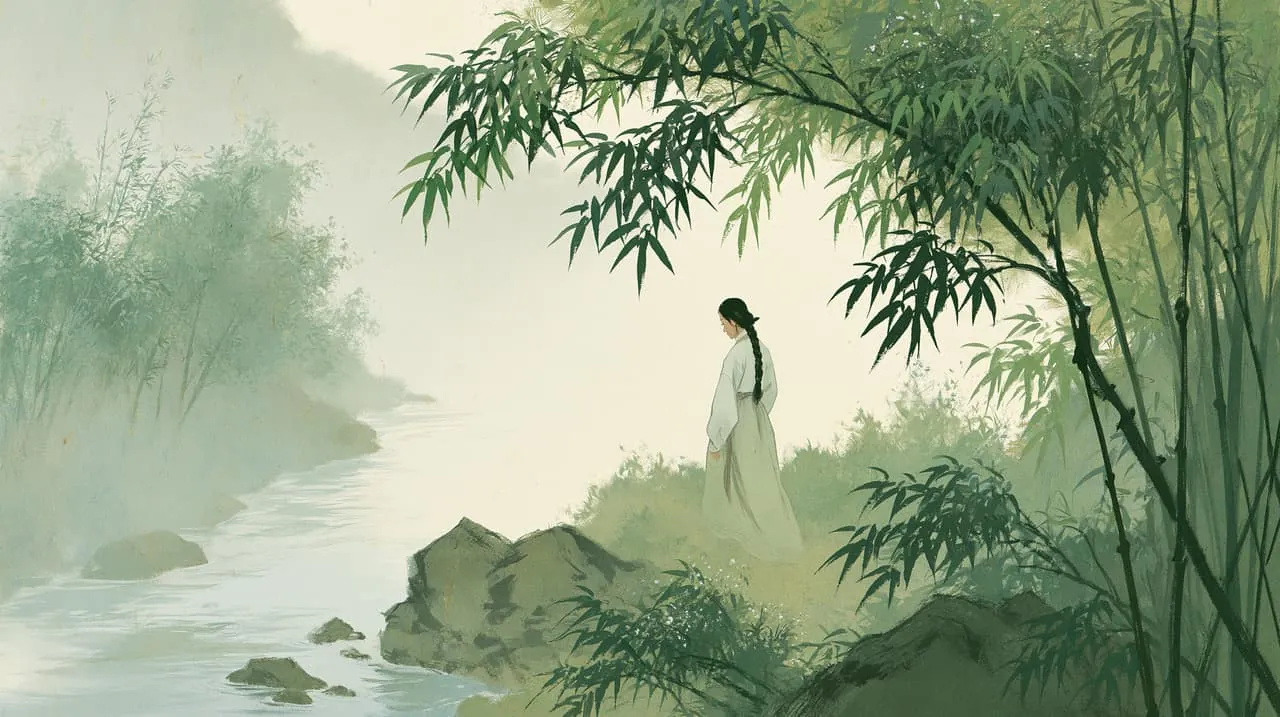
But Yin Fire specifically, 丁 (Jeong), isn't the sun. It's not Yang Fire's blazing, unignorable daylight. Yin Fire is a candle. A flame behind a screen. A lamp in a window that people walk past without looking in.
Yin Fire people have this aching, desperate need for recognition. They want to be seen more than almost any other Day Master type. The irony, and this is where Saju gets almost brutally poetic, is that they often create the exact conditions that make it impossible to be seen clearly. They perform. They wear masks (sometimes literally, sometimes metaphorically). They build elaborate systems of presentation that are really just armor around their terrified, luminous core.
I've worked with Yin Fire clients who are genuinely magnetic, captivating in conversation, the kind of people you remember for years. And almost every single one of them has said some version of: "No one actually knows me." That tension is Yin Fire's central wound.
Why She Destroys Everything She Loves
The villain's pattern in Mask Girl isn't random cruelty. Watch it again and you'll see it. Every act of destruction she commits is preceded by a moment where she could have asked for something directly. Could have said: look at me, acknowledge me, love me without the performance. She never does. She burns it down instead.
In Saju terms, this maps to one of the most dangerous dynamics in elemental theory: Fire controlled by Water (수극화, su-geuk-hwa). The controlling cycle tells us that Water extinguishes Fire. For a Yin Fire person whose chart is heavy in Water energy, or who enters a Water-dominant Grand Fortune period (대운 Daeun), the experience is suffocation. It's like watching your own flame gutter and not knowing how to feed it.
What happens when Fire can't radiate outward? It turns inward. It starts consuming whatever is closest.
She doesn't destroy people randomly. She destroys the people who got close enough to see her and then, in her perception, looked away anyway. The Yin Fire wound isn't abandonment exactly. It's almost worse: it's being present and still invisible.
The Mask as a Saju Symbol
Here's what really gets me about this show's imagery. The mask isn't just a narrative device. In elemental terms, it's a Fire person choosing to filter their own light. To control how much they're seen and from which angle.
This is so specifically Yin Fire behavior. Yang Fire (丙, Byeong) doesn't usually hide. It's the sun. It rises regardless. But Yin Fire curates. It decides who gets to see what warmth. And that curation becomes obsessive, then controlling, then lethal in extreme cases.
The show is essentially a character study in what happens when a Fire archetype's need for recognition gets no healthy outlet over decades. The Five Elements framework in Saju is very clear: Fire's emotional register is joy. But when Fire is perpetually suppressed or unseen, that joy curdles. It doesn't disappear. It transforms into something that looks like rage from the outside but feels, from the inside, like grief.
This connects to something fascinating in the Saju love reading framework. The pairings most likely to produce this kind of trapped energy? Fire and Water. Maximum chemistry, maximum risk of extinguishing each other. The show's relationships follow this pattern almost beat for beat.
The 12 Life Stages and Her Arc
Mask Girl as a series is structured in a way that mirrors something Saju calls the 12 Life Stages (십이운성). Each character phase the villain goes through maps onto these energy shifts in a way that genuinely gave me chills when I first noticed it.
Her early chapters feel like the Bathing stage (목욕, Mok-yok): emotionally turbulent, magnetically attractive, identity still forming. She's compelling precisely because she's unfinished. People are drawn to her the way people are drawn to a fire that might go out.
Her middle arc hits what I'd call the Peak stage (제왕, Je-wang): maximum output, maximum intensity, but also the point where there's nowhere to go but down. This is the classic Saju warning about the Peak phase. It's not a reward. It's a peak load warning. She's burning at maximum and the structure can't hold.
By the end, she's in something close to the Tomb stage (묘, Myo): compressed potential, hidden energy, isolated from the world that couldn't see her. Saju doesn't read this as defeat. It reads it as something dormant. Which, if you've finished the show, lands in a very specific, unsettling way.
What Yin Fire Needs That She Never Gets
I want to be honest about this part. Yin Fire energy doesn't inevitably become destructive. I've seen Yin Fire Day Masters build genuinely beautiful lives, careers in creative fields, performance, brand work, anything where their natural radiance gets a legitimate stage.
The difference is almost always the Useful God (용신 Yongsin). In Saju, every chart needs one element more than others to achieve balance. For a Yin Fire person in an unbalanced chart, the Useful God is often Wood (목, Mok). Wood feeds Fire. Wood says: you don't have to fight to exist, here's fuel, here's direction, here's a reason to keep burning forward.
What the villain never finds is anyone or anything that functions as Wood for her. No one who fuels her without trying to reshape or extinguish her. Every relationship she forms tips toward Water (suppression) or Metal (criticism, control). Nothing feeds her.
That's the tragedy Saju would name clearly. It's not that she was born bad. It's that her elemental needs were never met, and she had no framework to ask for what she actually needed.
If you want to understand what element your own chart needs most, this is genuinely worth exploring. The free Saju ebook breaks down how the Useful God concept works in plain language, which is a good starting point.
Frequently Asked Questions
What is Yin Fire energy in Korean Saju?
Yin Fire (丁火, Jeong-hwa) is one of the Ten Heavenly Stems in Saju. It represents candle-like illumination: focused, intimate, and deeply needing to be seen. Unlike Yang Fire (the sun), Yin Fire curates how and when it shines. People with a Yin Fire Day Master are often magnetic and creative but can struggle with feeling invisible despite their radiance.
Why do Yin Fire people hide when they want to be seen?
This is one of Saju's most bittersweet paradoxes. Yin Fire needs recognition more than almost any other elemental type, but its sensitivity to being unseen or misunderstood often causes it to filter itself, perform, or hide behind constructed personas. The mask becomes protective, then becomes a prison.
What element is most dangerous for Yin Fire in Saju?
An excess of Water energy is the classical challenge for Yin Fire. In the controlling cycle (상극), Water extinguishes Fire. When Yin Fire charts carry too much Water, or move through heavy Water periods in their Grand Fortune (대운 Daeun), the person can feel suffocated, invisible, and emotionally volatile.
Can Saju explain character archetypes from TV and film?
Yes, and this is one of the more interesting modern applications of Saju. Elemental analysis doesn't require a birth date. It reads patterns of behavior, motivation, emotional wounds, and relationship dynamics through the Five Elements framework. Fictional archetypes are often so resonant precisely because they embody real elemental energies we recognize from life.
The reason Mask Girl hits so hard isn't just good screenwriting. It's that the character is built around a genuinely ancient wound that Saju has had a name for centuries. The need to be seen, the terror of being seen, and the destruction that fills the space between those two things. That's Yin Fire. That's real. And if any of this felt uncomfortably familiar to you reading it, well. Your chart probably has something to say about that.
Discover Your Destiny
Curious about your own chart?
Get a free mini reading, then unlock your full Four Pillars report from a certified Saju master.