Napeum Ohaeng: The Sound Element Sitting Behind Each Pillar
Learn about Napeum Ohaeng, the hidden sound element behind each Saju pillar. A layer most readings miss that adds depth to your Four Pillars chart.

What Is Napeum Ohaeng and Why Does It Matter?
Napeum Ohaeng (납음오행) is one of those Saju concepts that most people skip right over, and honestly, even some practitioners gloss past it. But if you've ever felt like a standard Four Pillars reading captured about 80% of you and left something unexplained, this might be the missing piece. Napeum Ohaeng is the "sound element" that sits behind each pillar of your birth chart, an additional elemental layer derived not from the individual Heavenly Stem or Earthly Branch alone, but from the specific combination of the two together. It's old. It's subtle. And it adds a kind of background frequency to your chart that nothing else replicates.
Before we get into the mechanics, if you don't know your Four Pillars yet, grab your free reading first. You'll need to know your Heavenly Stems and Earthly Branches to make sense of what follows.
So let me break this down from the ground up.
The Origin of Napeum: Where Sound Meets Element
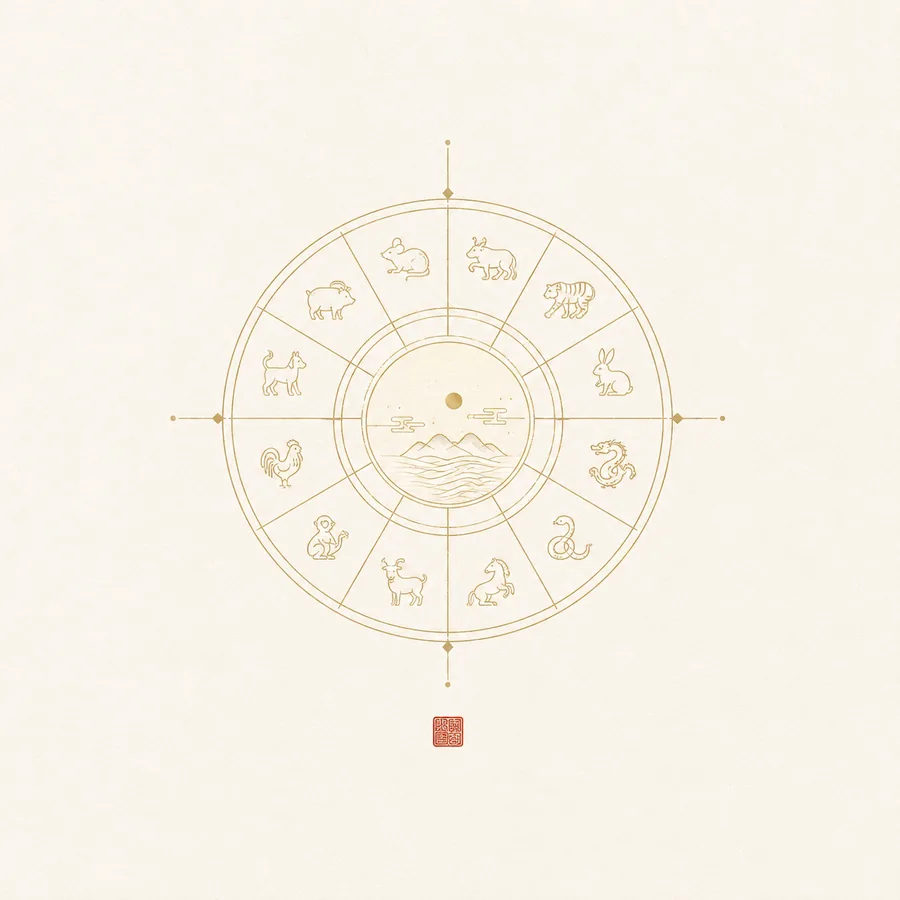
The term 납음 (Napeum) literally translates to something like "received sound" or "absorbed tone." The concept traces back to ancient Chinese cosmology, where the five musical notes (宮商角徵羽) were mapped onto the Five Elements (오행 Ohaeng): Wood, Fire, Earth, Metal, Water. Each note carried an elemental vibration, and when applied to the sixty Jiazi cycle (the full rotation of all Heavenly Stem and Earthly Branch pairings), every pair received its own elemental "sound."
This is not the same as the element of the Heavenly Stem. It's not the same as the element of the Earthly Branch. It's a third thing entirely.
Think of it this way. Your Day Master (일간 Ilgan) tells you who you are on the surface. The Branch elements tell you what resources and dynamics are at play in each pillar. But Napeum Ohaeng? It's more like the ambient hum underneath all of that. The texture. The undertone.
How Napeum Ohaeng Is Determined
Here's where it gets specific. The sixty Jiazi cycle pairs each of the 10 Heavenly Stems with each of the 12 Earthly Branches, creating 60 unique combinations. These 60 combinations are grouped into 30 pairs, and each pair is assigned one of 30 distinct Napeum identities. Each identity carries one of the Five Elements, but with a specific material or image attached.
For example:
- 甲子 (Gap-Ja) and 乙丑 (Eul-Chuk) share the Napeum of "Gold in the Sea" (海中金). Element: Metal.
- 丙寅 (Byeong-In) and 丁卯 (Jeong-Myo) share the Napeum of "Fire in the Furnace" (爐中火). Element: Fire.
- 戊辰 (Mu-Jin) and 己巳 (Gi-Sa) share the Napeum of "Great Forest Wood" (大林木). Element: Wood.
So the Napeum isn't just "Metal." It's a particular kind of Metal. Not just "Fire," but Fire contained in a specific vessel. This matters a lot because the imagery tells you about the quality and behavior of that element.
Gold buried under the ocean behaves nothing like a gold ring on someone's finger. Furnace fire is controlled, intensely hot, and purposeful, completely different from, say, "Fire on the Mountain" (山頭火), which is wild, visible, and exposed.
The 30 Napeum Categories
There are exactly 30 Napeum types, six for each element. Here they are grouped by element:
Metal Napeum: Gold in the Sea, Gold in the Sand, Wax Gold, Gold Foil, White Pewter Gold, Sword Edge Gold
Wood Napeum: Mulberry Wood, Pine & Cypress Wood, Great Forest Wood, Willow Wood, Pomegranate Wood, Flat Ground Wood
Water Napeum: Stream Water, Great River Water, Long-Flowing Water, Spring Water, Heavenly River Water, Great Sea Water
Fire Napeum: Thunderbolt Fire, Furnace Fire, Lantern Fire, Mountain Top Fire, Covering Light Fire, Heavenly Fire
Earth Napeum: Wall Earth, City Wall Earth, Great Post Road Earth, Roadside Earth, Sand Earth, Rooftop Earth
Each one carries a distinct personality. "Sword Edge Gold" is sharp, decisive, cutting. "Gold Foil" is delicate, decorative, thin. Both are Metal, but the vibe could not be more different.
How the Sound Element Sits Behind Each Pillar
Here's the thing most people miss. Every pillar in your Saju chart (Year, Month, Day, Hour) consists of a Heavenly Stem and Earthly Branch pair. That means every single pillar has its own Napeum Ohaeng sitting behind it.
So in a four-pillar chart, you don't just have one Napeum. You have four.
Take a hypothetical chart where someone's Day Pillar is 甲子 (Gap-Ja). Their Day Napeum would be "Gold in the Sea," a Metal element. But say their Year Pillar is 丙寅 (Byeong-In). That Year Napeum is "Furnace Fire." Their Month might be 庚午 (Gyeong-O), which carries "Roadside Earth." And their Hour might be 壬申 (Im-Sin), which is "Sword Edge Gold."
Now look at what just happened. The chart's surface elements could tell one story, but the Napeum layer reveals a secondary elemental composition running underneath. Maybe the visible chart looks Wood-heavy, but the Napeum layer is loaded with Metal and Fire. That tension between surface and undertone? That's where Napeum gets really interesting.
What Napeum Ohaeng Reveals That Standard Readings Don't
In my experience, the Napeum layer tends to show up in a few key ways:
Inner disposition vs. outer behavior. Someone might have a Water Day Master and seem calm and adaptive on the surface. But if their Day Pillar Napeum is "Thunderbolt Fire," there's an inner intensity, a sudden explosive quality, that doesn't show up in the standard reading. People around them might sense it without being able to name it.
Latent talents. Say someone's chart shows almost no Earth element anywhere in the stems and branches. They might struggle with stability and grounding. But if two or three of their Napeum elements are Earth, there's a hidden reservoir of steadiness they can access. It just takes more conscious effort.
Timing and resonance. When a Grand Fortune (대운 Daeun) or Annual Fortune (연운 Yeonun) period brings an element that matches your Napeum composition, you might feel a deep, almost unexplainable sense of alignment, even if it clashes with your surface chart. I've seen this pattern over and over, and it's one of the things that convinced me Napeum is worth taking seriously.
The Day Pillar Napeum: Your Core Sound
Among the four Napeum elements in a chart, the Day Pillar Napeum holds the most weight. This makes sense because the Day Pillar is where your Day Master sits. It's your core identity pillar. So the Napeum behind it becomes something like your soul's undertone.
If you want to understand deeper study concepts like this, the free Saju ebook is a solid starting point for building foundational knowledge before layering in Napeum.
Here's a practical way to think about it. Your Day Master element is what you are. Your Useful God (용신 Yongsin) is what you need. Your Day Pillar Napeum is something like what you carry without knowing it.
Someone with a Wood Day Master and a "Great Sea Water" Napeum on their Day Pillar carries an enormous depth beneath their outward growth-oriented personality. Water feeds Wood in the productive cycle (상생), so this Napeum actually supports the Day Master from below, like underground water nourishing roots. That's a quietly powerful configuration.
But flip it. A Fire Day Master with "Great Sea Water" as their Day Pillar Napeum? Water controls Fire (상극). There's an internal tension, a sense of being dampened from within, even when everything externally looks fine. This doesn't mean doom. It means there's a built-in complexity that standard readings might attribute to something else entirely.
Common Misconceptions About Napeum Ohaeng
Let me clear up a few things I see floating around online.
"Napeum replaces the regular Five Elements analysis." No. Absolutely not. Napeum is a supplementary layer. The primary reading of your chart, the Ten Gods (십신 Sipsin), the element balance, the Useful God, all of that remains the backbone. Napeum adds nuance. It doesn't override.
"Your Napeum element is your true element." Also no. Your Day Master is your core identity. Your Napeum element is more like a secondary coloring. Think of it as the difference between the color of a room's walls versus the ambient lighting. Both affect how the room feels, but one is structural and the other is atmospheric.
"Napeum is outdated and nobody uses it." This one bothers me. Yes, many modern practitioners focus on the stem-and-branch analysis and skip Napeum entirely. But in traditional Korean Saju practice, Napeum has a real place, especially when a chart seems contradictory or when someone's lived experience doesn't match the surface reading. It's one of those tools that separates a deep reading from a quick one.
How to Use Napeum Ohaeng in Your Own Chart
If you want to explore this yourself, here's a starting point:
- Look up your four pillar pairs (Year, Month, Day, Hour stem-branch combos).
- Find each pair's Napeum assignment from a Napeum Ohaeng reference table (these are standardized and haven't changed in centuries).
- Note the element and the specific imagery for each.
- Compare the Napeum elemental composition with your surface chart composition. Where do they agree? Where do they differ?
- Pay special attention to your Day Pillar Napeum and how it interacts with your Day Master through the productive and controlling cycles.
The imagery matters just as much as the element. "Stream Water" and "Great Sea Water" are both Water, but one is small, clear, and fast-moving while the other is vast, deep, and overwhelming. These qualities color how the element expresses itself in your life.
Frequently Asked Questions
What is Napeum Ohaeng in simple terms?
Napeum Ohaeng (납음오행) is an additional elemental layer in Korean Saju that assigns a specific "sound element" to each Heavenly Stem and Earthly Branch pair. It's derived from the 60 Jiazi cycle and gives each of the 30 pair groups a unique elemental identity with a descriptive image, like "Gold in the Sea" or "Thunderbolt Fire."
Is Napeum Ohaeng the same as my Day Master element?
No. Your Day Master (일간) comes from the Heavenly Stem of your Day Pillar alone. Napeum comes from the combination of both the Stem and Branch together, and it can be a completely different element. They coexist in your chart as different layers of information.
How important is Napeum Ohaeng compared to the standard Five Elements reading?
It's supplementary, not primary. The standard analysis of stems, branches, Ten Gods, and Useful God remains the foundation of any serious Saju reading. Napeum adds depth and can explain aspects of personality or timing that the surface chart doesn't fully capture. Think of it as the difference between reading a book and hearing the audiobook. Same content, different dimension.
Can Napeum Ohaeng affect compatibility readings?
Yes, it can add another angle to compatibility analysis. If two people's Day Pillar Napeum elements are in a productive relationship, there's often an unspoken ease between them that goes beyond what the standard chart comparison shows. For a deeper look at how elemental dynamics play out in relationships, you might want to check out a Saju love reading.
Napeum Ohaeng is one of those layers that rewards patience. It won't change the fundamental structure of your chart, but it can explain the stuff that nags at you. The parts of yourself that don't quite fit the main reading. The quiet pull toward something your surface elements don't account for. If you've ever felt like there's more to your chart than what you've been told, this might be where it lives.
Discover Your Destiny
Curious about your own chart?
Get a free mini reading, then unlock your full Four Pillars report from a certified Saju master.