Saju Calculator: How Your Birthday Becomes Four Pillars of Destiny
Learn what a Saju calculator does with your birthday, how the Four Pillars are built from Heavenly Stems and Earthly Branches, and what the results mean.
A saju calculator takes four simple inputs, your birth year, month, day, and hour, and converts them into eight characters arranged across four columns. Each column is called a pillar. Together, the four pillars form your saju chart (사주팔자), a personal map of timing, temperament, and life direction that Korean fortune tellers have used for over a thousand years.
If you have never seen your pillars before, you can get your free saju reading here in about two minutes. All you need is your birthday and birth time.
In this article I will walk through exactly what a saju calculator does behind the scenes, how each pillar is built, and what you should look for once you have your results. I have been reading saju charts professionally for over 15 years, and one thing I see constantly is people running a calculator, getting a grid of characters, and then having no idea what to do with them. This guide fixes that.
What a Saju Calculator Actually Does
Every saju calculator maps a specific moment in time to the traditional East Asian calendar system. That system uses two cycles running in parallel:
- Ten Heavenly Stems (천간, Cheongan): 甲 乙 丙 丁 戊 己 庚 辛 壬 癸. These rotate through the Five Elements (Wood, Fire, Earth, Metal, Water), each in a Yang (+) or Yin (-) form.
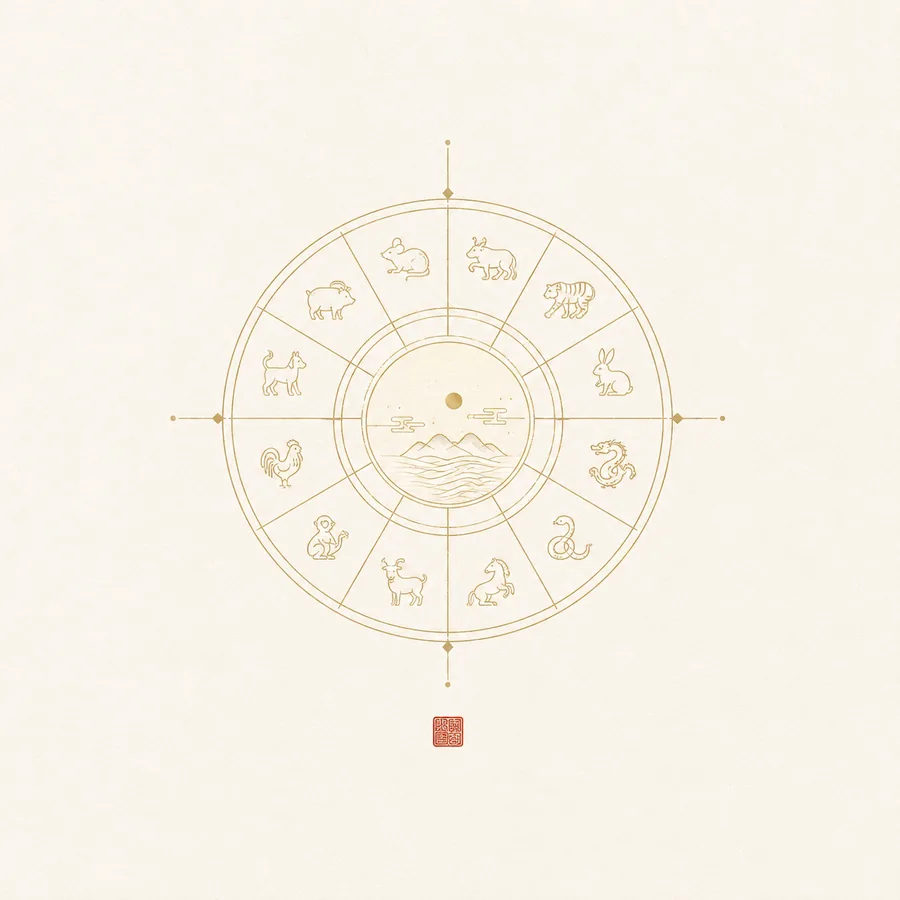
- Twelve Earthly Branches (지지, Jiji): 子 丑 寅 卯 辰 巳 午 未 申 酉 戌 亥. These correspond to the twelve zodiac animals: Rat, Ox, Tiger, Rabbit, Dragon, Snake, Horse, Goat, Monkey, Rooster, Dog, and Pig.
A saju calculator pairs one stem with one branch for each of the four time units: year, month, day, and hour. That gives you four pairs, which is eight characters total. In Korean, 사주 (sa ju) literally means "four pillars" and 팔자 (pal ja) means "eight characters."
The stem tells you the elemental quality. The branch tells you the animal energy and the hidden elements inside it. Every branch contains one to three hidden stems, which means your chart holds far more information than the eight surface characters suggest.
The Four Pillars a Calculator Builds
Year Pillar: Your Social Generation
The year pillar is the one most people already know. If you were born in 1990, your year pillar is 庚午, Yang Metal Horse. Born in 1995, it is 乙亥, Yin Wood Pig.
In saju, the year pillar represents your outer social identity, the generation you belong to, and how the world first perceives you. It also connects to your relationship with grandparents and ancestors in the traditional reading framework.
The year pillar repeats on a 60-year cycle. That means 1964 and 2024 share the same year pillar (甲辰, Yang Wood Dragon), but everything else in their charts will differ because the month, day, and hour pillars are different.
Month Pillar: Your Career and Parents
The month pillar depends on which of the 24 solar terms (절기, jeolgi) your birthday falls within. This is not the same as the Western calendar month. The solar terms divide the year by the sun's actual position, so the boundaries shift by a day or two each year.
For example, someone born on February 3 might land in the previous month's term or the next one depending on the exact year. A good saju calculator handles this conversion automatically using an astronomical almanac.
The month pillar governs your career instincts, your relationship with your parents, and your social ambitions. It is the pillar most connected to how you operate in professional environments.
Day Pillar: Your Core Self
The day pillar is the most important column in the entire chart. It represents your innermost nature, your default way of thinking, and the "day master" (일간, ilgan), which is the single stem at the top of this pillar, serves as the reference point for interpreting everything else.
The day pillar follows a strict 60-day cycle with no exceptions. Say someone is born on May 15, 1990. Their day pillar index is calculated as (Julian Day Number + 49) mod 60, which gives 庚辰, Yang Metal Dragon. That Metal stem becomes their day master, and every other element in the chart is read in relation to it.
If you are curious about what your day master reveals about your personality and relationships, the saju love reading breaks this down in detail.
Hour Pillar: Your Inner World and Legacy
The hour pillar divides the day into twelve two-hour blocks, each assigned to one of the twelve branches. The first block (子時, Rat hour) runs from 23:00 to 00:59. The hour pillar captures your private self, your subconscious tendencies, and in traditional readings, your relationship with your children and the legacy you leave.
Many online calculators skip the hour pillar entirely or treat it as optional. That is a problem. Without the hour pillar, you are working with only six of your eight characters, and the reading loses an entire dimension.
How the Math Works Behind the Scenes
The year pillar formula is straightforward. Take the birth year, subtract 4, then find the remainder when divided by 10 for the stem and by 12 for the branch. So for the year 2000: (2000 minus 4) mod 10 = 6, which is the seventh stem (庚, Yang Metal), and (2000 minus 4) mod 12 = 4, the fifth branch (辰, Dragon). Result: 庚辰, Yang Metal Dragon.
The day pillar uses the Julian Day Number. Convert the birthday to JDN, add 49, then take mod 60. The resulting index maps directly to one of the 60 stem-branch pairs. This cycle has run unbroken for thousands of years and produces the same result regardless of which calculator you use, as long as the implementation is correct.
The month and hour pillars are trickier. The month stem depends on the year stem (following a fixed pairing rule), and the hour stem depends on the day stem. This interlocking design means changing one birth detail can cascade through the entire chart.
If you want to explore these patterns through a full book-length treatment, the Saju Book covers every element and star combination in one place.
What a Calculator Cannot Tell You
A calculator gives you the raw chart. It does not give you the interpretation. Here is what falls outside the calculator's scope:
Element balance. Your chart contains a mix of Wood, Fire, Earth, Metal, and Water. A calculator can list them, but deciding which element is your "useful god" (용신, yongshin), the one your chart most needs, requires experience and judgment. Two charts with identical element counts can have completely different useful gods depending on the season of birth and the relationships between branches.
Luck cycles. Your 10-year luck cycles (대운, daeun) and annual luck (세운, seun) are calculated from the month pillar and your gender, but interpreting how a new luck cycle interacts with your original chart takes training. A favorable element arriving in your luck cycle does not automatically mean good fortune if it clashes with a branch in your natal chart.
Star patterns. Traditional saju identifies special stars (신살, sinsal) such as the Nobleman Star, the Peach Blossom, or the Void Pillar by checking specific branch combinations. A calculator can flag these, but explaining what they mean in context is the reader's job.
If your dream symbols have been unusually vivid or repetitive lately, that often correlates with a luck cycle transition, something a calculator alone would never catch.
How to Read Your Results Once You Have Them
Once you run your birthday through a saju calculator, look at these three things first:
1. Identify your day master. This is the top character (the stem) of your day pillar. It is one of ten options: 甲 or 乙 (Wood), 丙 or 丁 (Fire), 戊 or 己 (Earth), 庚 or 辛 (Metal), 壬 or 癸 (Water). Your day master determines how every other element in the chart relates to you.
2. Count your elements. Tally up how much Wood, Fire, Earth, Metal, and Water appear across all four pillars (including the hidden stems inside each branch). If one element dominates or one is completely absent, that imbalance shapes your personality and your luck pattern.
3. Check for repeating branches. If the same branch appears twice (say, two Horses or two Tigers), the chart amplifies that energy. If opposing branches appear (say Horse and Rat, which form a direct clash), tension between those life areas becomes a central theme.
These three steps give you a basic orientation before going deeper into star patterns, luck cycles, and relationship compatibility.
Frequently Asked Questions
Is a saju calculator the same as a Chinese astrology calculator?
They share the same stem-and-branch system, but Korean saju (사주) and Chinese bazi (八字) diverge in their interpretive traditions. Korean saju places heavier emphasis on the monthly solar terms, the concept of the useful god (용신), and specific star patterns like the Nobleman Star or the Void Pillar. A calculator built for one system may not apply the same interpretive rules as the other.
Why do different saju calculators give different results?
The most common reason is disagreement on where the day boundary falls. Some calculators treat midnight as the day change; others follow the traditional convention where the new day starts at the Rat hour (23:00). Another source of discrepancy is the month boundary: calculators using the lunar calendar instead of the 24 solar terms will assign different month pillars for birthdays near the start or end of a month.
Do I need my exact birth time for a saju calculator?
You need it for a complete reading. Without the birth hour, the calculator cannot produce the hour pillar, which means you lose two of your eight characters. The day master and the other three pillars still work, but the reading is incomplete. If you do not know your birth time, a skilled saju reader can sometimes narrow it down based on personality traits associated with each two-hour block.
Can I trust a free online saju calculator?
For the basic four-pillar output, most reputable calculators are reliable because the math is deterministic. Where they differ is in interpretation depth, star identification, and luck cycle analysis. If you want more than raw pillars, a professional saju reading from an experienced practitioner will give you the context that a calculator alone cannot provide.
Discover Your Destiny
Curious about your own chart?
Get a free mini reading, then unlock your full Four Pillars report from a certified Saju master.