Saju vs BaZi: Where Korean and Chinese Four Pillars Split
Saju and BaZi build the same chart and then read it differently. The points where the two traditions actually disagree.

Saju vs BaZi: Is Korean Four Pillars Really Different from Chinese?
If you've been researching Korean Saju and stumbled across Chinese BaZi, you're probably wondering: are these literally the same thing? Short answer, no. Long answer, it's complicated in the most interesting way. Both systems trace back to the same ancient Chinese roots, but over centuries of cultural evolution, Korean Saju developed its own distinct flavor, interpretive layers, and philosophical emphasis. I get asked about this constantly, so let me finally give this question the thorough answer it deserves.
The Shared Foundation: What Saju and BaZi Actually Have in Common
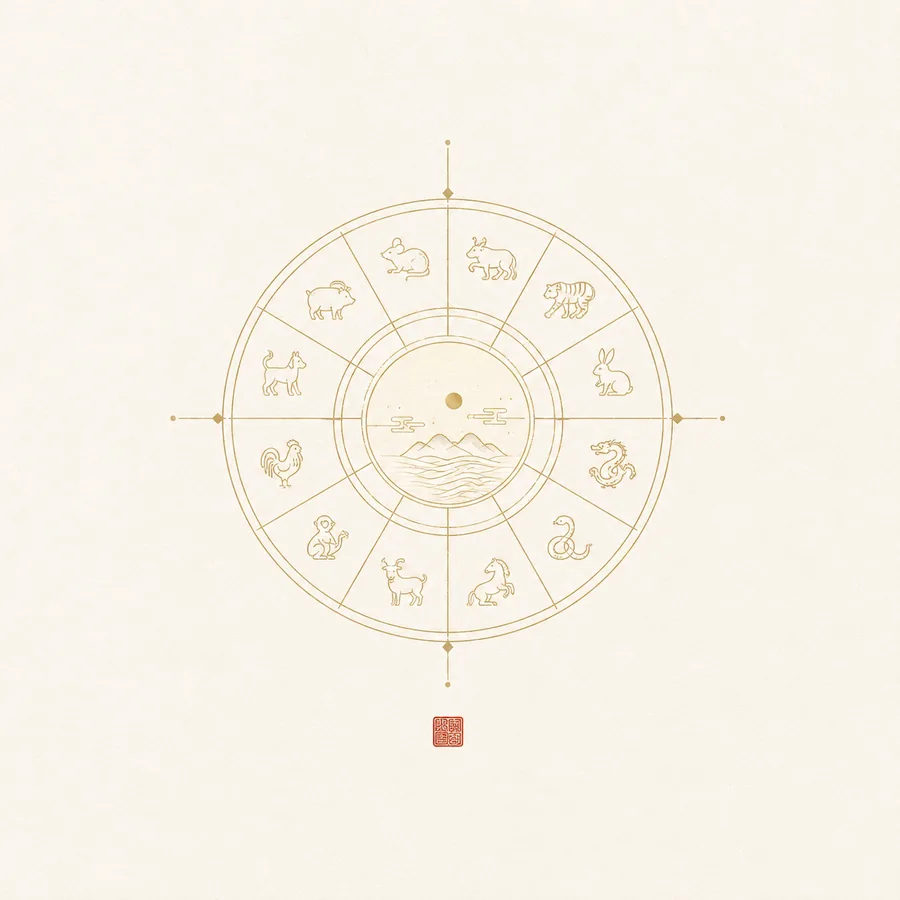
Both Saju (사주) and BaZi (八字) translate roughly to "Eight Characters" or "Four Pillars of Destiny." The core structure is identical: your birth date and time are broken down into four pillars (year, month, day, and hour), each containing a Heavenly Stem and an Earthly Branch. That gives you eight characters total, hence the name.
Both systems use the ten Heavenly Stems, twelve Earthly Branches, the five elements (Wood, Fire, Earth, Metal, Water), and the concept of yin and yang. The 60-year cycle of stems and branches is shared. So is the basic idea that your birth chart reveals your innate nature, relationships, career tendencies, and life timing.
So yeah, the bones are the same. But the practice? That's where things get genuinely different.
Where Korean Saju Diverges from Chinese BaZi
The Role of the 10 Gods (십신, Sipsin)
This is probably the biggest practical difference. Both systems use the Ten Gods (also called Ten Stars or Ten Deities), but Korean Saju places an almost obsessive emphasis on them. In my practice, the Sipsin are the primary lens through which I read personality, relationships, and life events. Korean practitioners spend years studying just this one framework.
Chinese BaZi teachers I've encountered tend to vary more widely. Some emphasize the Ten Gods heavily, others focus more on Daymaster strength, elemental balance, or the special star combinations (known as Shen Sha or auxiliary stars). The interpretive priorities feel different at the practitioner level.
Daymaster Strength: A Contested Concept
Here's the thing. In modern Chinese BaZi, there's a major school of thought called "Useful God" (用神, Yongsheng) theory, which revolves heavily around whether your Daymaster is "strong" or "weak" and identifying the element that balances it. This is foundational in many Chinese BaZi schools.
Korean Saju practitioners are more divided on this. Some follow similar logic, but a significant portion of Korean Saju teaching downplays rigid strong/weak classifications and focuses more on the relational dynamics between all eight characters, especially through the Ten Gods lens. In my experience, Korean readings tend to feel more narrative and less formulaic as a result.
The Interpretation Style Itself
Chinese BaZi, especially as taught in the Chinese-speaking world or by prominent modern teachers like Joey Yap, tends to have a more structured, almost engineering-like approach. There are frameworks, rules, classifications. Some practitioners almost work like a checklist.
Korean Saju has always felt more intuitive to me. There's a storytelling quality to how Korean masters read a chart. They're looking at how the characters interact, what tensions exist, what the chart "wants." It's less about categorizing and more about feeling the flow of the chart.
This isn't a better-or-worse thing. It's just genuinely different philosophical DNA.
Regional Calendar and Time Zone Considerations
This one is technical but important. Both systems technically use the same lunisolar calendar, but Korean practitioners have historically applied different time zone adjustments, especially for birth hours. Korea used to use local solar time rather than standard Korean Standard Time (KST) for Saju calculations, and many traditionalists still do.
This can change your hour pillar, which affects your Saju chart pretty significantly. I always ask clients whether they know their actual birth location and time because even a difference of 30 minutes can shift the reading. Chinese BaZi practitioners have their own regional debates about this too, but the specific adjustments differ.
Cultural Symbolism and Additional Layers
Korean Saju has incorporated uniquely Korean cultural and spiritual elements over the centuries. Concepts like "Gwanssal" (관살, the influence stars related to authority and control) carry slightly different social weight in Korean readings, often tied to Korean Confucian values around career, hierarchy, and family duty.
There are also certain sub-frameworks in Korean Saju, like the 12 Stages of Life (포태법, Potaebeop) and specific interpretation of spirit stars, that feel distinctly shaped by Korean cultural context rather than purely by Chinese classical texts.
Which System Should You Use?
Honestly, this is the wrong question. If you're Korean or your chart is being read by a Korean practitioner using Korean Saju methodology, you're getting Saju. If you're working with a Chinese BaZi consultant, you're getting BaZi. The framework you use matters less than the skill and depth of the practitioner reading it.
That said, if you're curious about which one resonates with you, I'd say: try both. Get a Saju reading from a Saju perspective and compare it to a BaZi reading you might find elsewhere. Notice which interpretation feels more accurate to your lived experience. That's genuinely useful information.
What I will say is that Korean Saju, in my 15+ years of practice, has an incredible depth when it comes to reading relationships and emotional patterns. The way the Ten Gods map onto your interpersonal dynamics is something I haven't seen matched in most BaZi readings I've encountered.
Common Misconceptions Worth Clearing Up
People often assume that because both systems use the same base characters, any Four Pillars reading is interchangeable. It's not. The same birth chart can produce different interpretations depending on which school of thought your practitioner follows.
I've had clients come to me after getting a BaZi reading elsewhere, and sometimes the findings align closely, but sometimes they're reading the same chart in nearly opposite ways. Neither reading is "wrong" necessarily. They're using different interpretive frameworks built on the same foundation.
Another misconception: Korean Saju is just a copy of Chinese BaZi. That's both historically inaccurate and a little reductive. Korea has had its own lineage of Saju scholarship going back centuries. The texts, the teachers, the cultural context, all of it developed independently enough to be considered its own tradition.
Frequently Asked Questions
Is Korean Saju the same as Chinese BaZi?
They share the same foundational system (Four Pillars of Destiny using Heavenly Stems and Earthly Branches), but they are not identical. Korean Saju has developed distinct interpretive frameworks, cultural emphasis, and reading styles over centuries. Think of them as cousins, not twins.
Which is more accurate, Saju or BaZi?
Accuracy depends far more on the skill of the practitioner than on the system itself. Both Saju and BaZi can produce deeply accurate readings. The better question is which practitioner and methodology resonates with your experience of life.
Do Korean Saju and Chinese BaZi use the same birth chart?
They use the same basic structure (year, month, day, and hour pillars) and the same 60-year stem-branch cycle. However, time zone and solar time adjustments may differ between Korean Saju and Chinese BaZi practitioners, which can occasionally produce different hour pillars for the same birth time.
Can I use a Chinese BaZi calculator for Korean Saju?
Not ideally. Some calculations will overlap, but a proper Korean Saju reading uses specific Korean interpretive frameworks, particularly around the Ten Gods (Sipsin) and certain auxiliary star systems. For the most accurate Korean Saju reading, you want a tool or practitioner trained specifically in the Korean tradition.
The Bottom Line

Saju and BaZi are two branches from the same ancient tree. They share a root system, speak the same symbolic language, and ask the same fundamental question: what does your birth moment reveal about your life path?
But Korean Saju has grown into its own tradition, with its own masters, texts, and cultural depth. If you want to understand yourself through the Korean Four Pillars lens specifically, the nuances matter. The emphasis on Ten Gods, the narrative reading style, the Korean cultural context around relationships and career, these things make Saju its own experience.
Ready to see what your actual Saju chart says about you?
Discover Your Destiny
Curious about your own chart?
Get a free mini reading, then unlock your full Four Pillars report from a certified Saju master.