The Twelve Branches Are Not the Twelve Animals
The zodiac animals are just nicknames. Here's what the Twelve Earthly Branches actually mean in Korean Saju and why it matters for your reading.
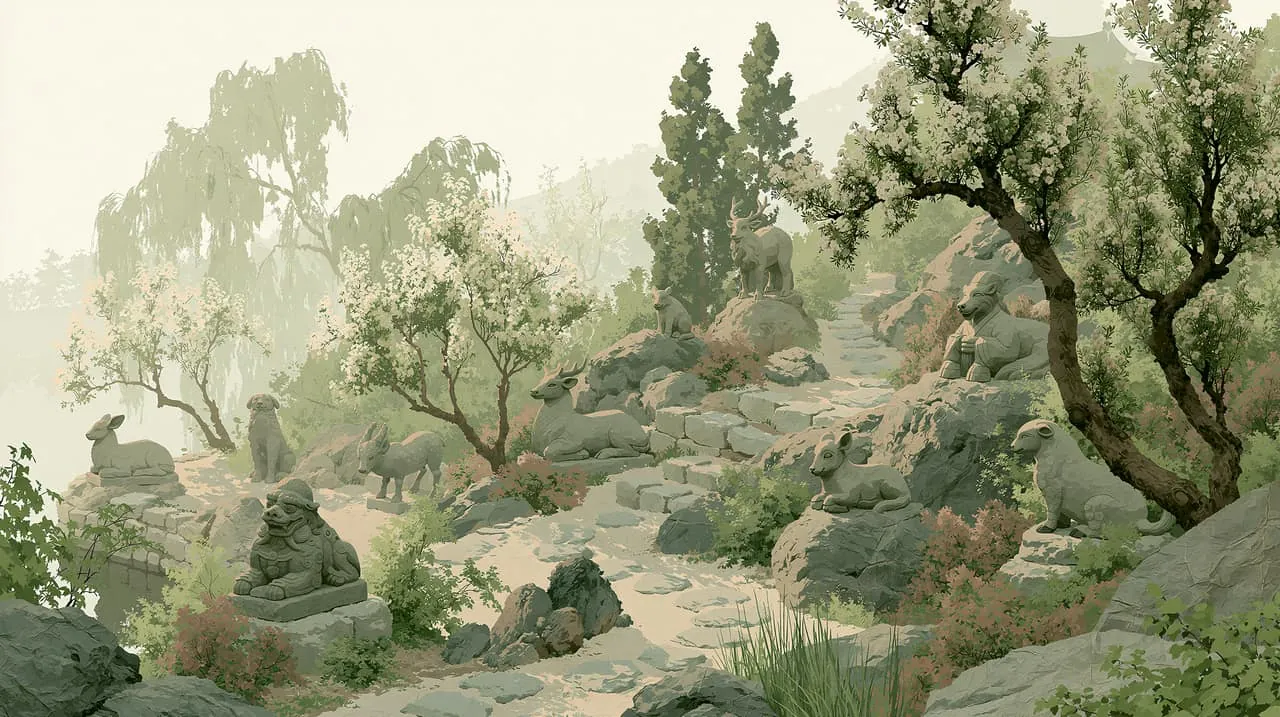
The Twelve Branches Are Not the Twelve Animals (And Most People Get This Wrong)
Let me say this clearly upfront: the Rat, Ox, Tiger, Rabbit and the rest of the zodiac animals? They're nicknames. Memory aids. They are not what the Twelve Earthly Branches actually are in Korean Saju. And if you're building your understanding of Four Pillars of Destiny on those animal symbols alone, you're working with maybe 10% of the real picture. If you want to see how deep this actually goes for your own chart, grab a free reading and you'll immediately see what I mean.
I've been doing Saju readings for over 15 years, and the animal zodiac misconception is probably the single most common thing I have to unpack in sessions. People come in saying "I'm a Dragon" or "I'm a Rabbit" like that's their whole identity. And it's not wrong exactly, it's just... wildly incomplete.

What the Twelve Earthly Branches Actually Are
The Twelve Earthly Branches (지지, Jiji) are one of the two fundamental building blocks of Saju. Each of the Four Pillars (Year, Month, Day, Hour) has two components: a Heavenly Stem (천간, Cheonjin) on top and an Earthly Branch on the bottom.
The Branches are elemental energy containers. Each one holds a specific element, a specific season, a specific time of day, a specific direction, and specific hidden stems inside it. The animals got assigned to these Branches simply because ancient practitioners needed an easy way to teach the system to regular people. The Rat got assigned to the Branch called 자 (Ja), the Ox to 축 (Chuk), Tiger to 인 (In), and so on.
But here's what actually matters: 자 (Ja) is not "the Rat." It's Water energy, peak winter, midnight hour, the direction North. The Rat is just its costume.
The Hidden Stems: This Is Where It Gets Real
Each Earthly Branch holds what are called hidden stems (지장간, Jijanggan) inside it. Think of a Branch as a house, and the hidden stems are the residents living inside. This is the part most people have never even heard of.
For example, the Branch 인 (In), which people know as "the Tiger," actually contains three Heavenly Stems inside it: 무 (Mu / Yang Earth), 병 (Byeong / Yang Fire), and 갑 (Gap / Yang Wood). Yang Wood is the main resident, but the others are in there too, influencing everything.
So when I look at someone's chart and I see 인 (In) in their Day Pillar Branch, I'm not thinking "oh, they're a Tiger." I'm thinking: there's a Yang Wood Day Master situation potentially in play here, plus Fire and Earth energy underneath the surface. Those hidden stems interact with the Heavenly Stems in complex ways that completely change the reading.
This is why two people born in the same animal year can have radically different charts and radically different life paths.
Elemental Energy by Branch: A Quick Breakdown
Here's the actual elemental identity of each Branch, stripped of the animal costume:
Wood Branches:
- 인 (In / Tiger): Yang Wood, Spring begins, dawn hours
- 묘 (Myo / Rabbit): Yin Wood, Spring peak, early morning
Fire Branches:
- 사 (Sa / Snake): Yang Fire, Summer begins
- 오 (Oh / Horse): Yin Fire, Summer peak, noon
Earth Branches (transitional):
- 축 (Chuk / Ox): Yin Earth, late Winter transition
- 진 (Jin / Dragon): Yang Earth, late Spring transition
- 미 (Mi / Goat): Yin Earth, late Summer transition
- 술 (Sul / Dog): Yang Earth, late Autumn transition
Metal Branches:
- 신 (Shin / Monkey): Yang Metal, Autumn begins
- 유 (Yu / Rooster): Yin Metal, Autumn peak
Water Branches:
- 자 (Ja / Rat): Yang Water, Winter peak, midnight
- 해 (Hae / Pig): Yin Water, Winter begins, late night
Notice that four of the twelve Branches are Earth. This is not a coincidence. In Saju, Earth is the transitional element that exists between every seasonal shift. Earth doesn't get a single season because it IS the transition between seasons.
Why This Actually Changes Your Reading
So what does this actually mean for you, practically?
When a Saju practitioner says you're entering a 대운 (Daeun / Grand Fortune) in the Branch 유 (Yu / Rooster), they're not saying a rooster is ruling your life for 10 years. They're saying Yin Metal energy is becoming dominant. If your chart's 용신 (Yongsin / Useful God) is Metal, this is a powerful, supportive decade. If Metal controls your Day Master's element, things are about to get harder.
The animal label tells you nothing about that. The elemental identity tells you everything.
I've had clients whose entire life changed after understanding this. One woman came in convinced her "Snake year" would be lucky because Snakes are clever and she liked the symbolism. But 사 (Sa) is Yang Fire, and Fire was the element her chart had in excess. More Fire was actually going to be stressful for her. Understanding the branch as energy rather than as an animal allowed her to prepare.
For anyone wanting to understand how these elemental dynamics play out in relationships specifically, a Saju love reading gets into exactly how your Branch energies interact with a partner's.
Branch Relationships: The Real Astrology
Here's another layer most people completely miss: the Branches form relationships with each other. These aren't animal friendships. These are elemental chemistry.
The three harmony combinations (삼합 Samhap) are groupings of three Branches that produce a dominant element together:
- 인 (In) + 오 (Oh) + 술 (Sul) = Fire trinity
- 해 (Hae) + 묘 (Myo) + 미 (Mi) = Wood trinity
- 신 (Shin) + 자 (Ja) + 진 (Jin) = Water trinity
- 사 (Sa) + 유 (Yu) + 축 (Chuk) = Metal trinity
There are also opposition clashes (충 Chung) between Branches that sit directly opposite each other on the cycle. 자 (Ja/Water) clashes with 오 (Oh/Fire). 인 (In/Wood) clashes with 신 (Shin/Metal). These clashes are elemental conflicts, not cosmic grudges between animals.
When someone says "Dragons and Dogs are incompatible," that's the animal shorthand for the 진-술 (Jin-Sul) clash, which is an Earth-versus-Earth conflict with specific elemental tension. The animals are fine. It's the energy underneath that matters.
Frequently Asked Questions
What exactly are the Twelve Earthly Branches in Saju?
The Twelve Earthly Branches (지지, Jiji) are elemental time and energy markers that form the bottom half of each pillar in a Four Pillars of Destiny chart. Each Branch carries a primary element, hidden stems inside it, a season, a direction, and a time of day. The zodiac animals are traditional memory labels assigned to these Branches, not the Branches themselves.
Are the zodiac animals useless in Saju?
Not entirely. The animal names are helpful shorthand and do carry some cultural and symbolic meaning. But relying on them alone means missing the hidden stems, elemental interactions, clash and harmony combinations, and seasonal dynamics that make Saju readings accurate. Think of the animals as book covers. The real content is inside.
What are hidden stems (지장간 Jijanggan) in the Branches?
Each Earthly Branch contains one to three Heavenly Stems hidden within it. These hidden stems influence how the Branch interacts with the rest of the chart, especially the Day Master (일간 Ilgan). A skilled practitioner reads these hidden stems to understand deeper character traits, relationship dynamics, and life patterns that a surface-level animal reading would never reveal.
Does my birth year animal really define my personality?
In classical Saju, the Year Pillar represents your outer social persona and family/ancestral influences, not your core identity. Your core identity comes from the Day Master, which is the Heavenly Stem of your Day Pillar, not your birth year animal. Many people are using the wrong pillar entirely when they identify with their zodiac sign.
The Bottom Line
The Twelve Branches are seasonal and elemental forces encoded into a time-tracking system that's been refined over thousands of years. The animals are wonderful. They're culturally meaningful, they're memorable, and there's genuine symbolic richness in them. But they are not the system.
Real Saju reads the elements, the hidden stems, the clashes, the harmonies, the 대운 (Daeun) cycles. That's where your actual life story lives.
If you want to stop reading your horoscope and start reading your chart, I'd also recommend picking up the free Saju ebook to get grounded in how the full system works before your next reading.
Discover Your Destiny
Curious about your own chart?
Get a free mini reading, then unlock your full Four Pillars report from a certified Saju master.