Why Saju Survived 1500 Years Without Being a Science
Saju isn't science, yet it's lasted 1500 years. Here's why this Korean Four Pillars system keeps working when modern logic says it shouldn't.
Why Saju Survived 1500 Years Without Being a Science
Saju isn't peer-reviewed. It can't be measured in a lab. No double-blind study has confirmed that your Day Master element predicts your personality. And yet, here we are, 1500 years later, and people across Korea, Japan, China, and now the entire English-speaking world are pulling up their birth charts and nodding their heads going, "wait, that's actually me."
So what's going on? If you've ever wondered whether Saju is "real" before getting a free reading, this post is for you.
Let me be upfront about something. I am not going to argue that Saju is science. It's not. But I do think the framing of "it must be science to be valid" is one of the most limiting ways to approach this system. Something can be non-scientific and still carry enormous wisdom. And Saju is a perfect example of that.

The 1500-Year Filter Nobody Talks About
Here's a thought experiment. Imagine you run a system for predicting human behavior and timing major life events. You use it with real people, across real generations. If the system is nonsense, it gets abandoned. Quietly, slowly, but eventually people stop paying for something that consistently fails them.
Saju didn't get abandoned. It survived dynastic collapses, colonization, rapid modernization, and the rise of neuroscience and behavioral psychology. That's not nothing.
I think of this as the 1500-year filter. Systems that survive that long without institutional support (no Church backing it, no government mandate) do so because they keep delivering something useful to real human beings. That doesn't make it science. But it does make it worth taking seriously.
In my 15 years of doing readings, the clients who get the most out of Saju are the ones who treat it like a very sophisticated mirror, not a magic 8-ball.
What Saju Actually Does (And Why That's Enough)
The core of Saju is the Four Pillars: Year, Month, Day, and Hour of birth. Each pillar has a Heavenly Stem and an Earthly Branch, encoding elemental energy from the Five Elements system (Wood, Fire, Earth, Metal, Water). Your Day Master, the Heavenly Stem of your Day Pillar, represents your core identity. Everything else in the chart is read in relationship to that anchor.
So what does this system actually do?
It maps relationship dynamics. The Ten Gods (십신, Sipsin) describe ten distinct relationship archetypes between any element and your Day Master. These aren't vague. They differentiate between the energy of a controlling parent figure versus a nurturing one, between a competitive peer and a supportive colleague. When I show clients their Ten Gods profile, the reaction is almost always the same: "How did you know that about me?"
It maps time. This is the part most people sleep on. Grand Fortune (대운 Daeun) gives you 10-year periods derived from your Month Pillar. Annual Fortune (연운 Yeonun) overlays the current year's elemental energy on your chart. A favorable Grand Fortune period can carry you through a rough year. An unfavorable decade can make even a good year feel like swimming upstream. I've used this framework to help clients understand why a particular stretch of their life felt inexplicably hard despite doing everything "right."
That's not science. But it is pattern recognition built over centuries of human observation.
The Language Problem
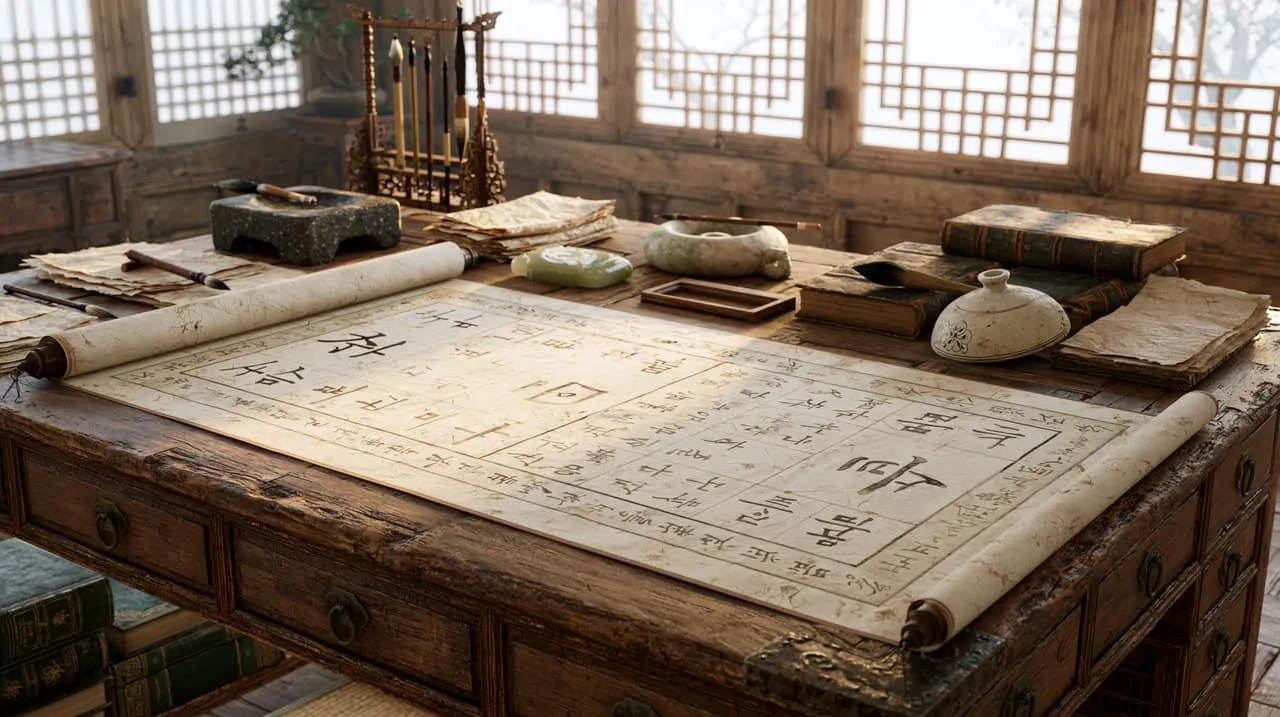
One reason Saju gets dismissed is the language it uses. Five elements. Heavenly Stems. Earthly Branches. Useful God (용신, Yongsin). These words sound mystical, even superstitious, to modern ears trained on clinical vocabulary.
But think about what psychology does. It takes something as messy and invisible as human inner experience and gives it labels: attachment styles, cognitive distortions, shadow selves. The labels aren't the truth. They're handles. Ways to talk about patterns that are real but hard to articulate.
Saju does the same thing with a different vocabulary. When I tell someone their chart lacks Water and their Useful God (Yongsin) is Water, I'm pointing to a real pattern I can observe in how they handle emotion, how they process information, and where they tend to burn out. The word "Water" is a handle, not a literal wetness.
The problem is that modern Western culture has a specific trust relationship with certain vocabularies (scientific, clinical, statistical) and deep suspicion of others. That suspicion is understandable. But it causes people to miss systems that carry genuine insight just because the packaging looks old.
What Science Can't Yet Measure
Here's the thing. Science is not a fixed entity. It's a method that expands as our tools get better. A hundred years ago, epigenetics didn't exist. The idea that trauma could be encoded in how genes express across generations would have sounded like mysticism.
Saju works with time and elemental cycles in a way that modern science hasn't mapped. That's not a deficit of Saju. It might be a deficit of current measurement tools.
The Productive Cycle (상생) in Saju describes how elements nurture each other: Wood feeds Fire, Fire creates ash that becomes Earth, Earth contains Metal, Metal gathers Water through condensation, Water feeds Wood. The Controlling Cycle (상극) describes tension: Metal cuts Wood, Wood breaks Earth, Earth dams Water, Water extinguishes Fire, Fire melts Metal. These dynamic relationships between forces are not static categories. They're motion-based, relational, and context-dependent.
Honestly, the closest Western framework to this is systems theory, specifically how complex systems regulate themselves through feedback loops. Saju has been doing systems thinking for 1500 years. It just uses different words.
Why People Keep Coming Back
I'll tell you what I've actually seen in practice, because this matters more than theory.
People come to me after a breakup, a job loss, or a health scare. They want to know: did I cause this? Is this over? When does it get better? Science gives them diagnoses and statistics. Therapy gives them frameworks and tools. Both are valuable. Neither answers "why now?"
Saju answers "why now" through Grand Fortune timing. When someone is in an unfavorable Daeun period and an unfavorable annual overlay at the same time, I can say: this isn't a character flaw. This is a hard weather pattern. It will shift. And I can usually tell them roughly when.
That's not therapy. It's not medicine. But for a lot of people, it's the piece that makes everything else make sense.
If you're curious about how these patterns show up in relationships specifically, a Saju love reading looks at elemental compatibility between two charts and how your Ten Gods interact with someone else's energy. It's one of the most practical applications of the system.
The Real Reason It Survived
Saju survived because it serves a need that science doesn't fully address: the need to feel like your life has a shape. That the hard years meant something. That there's a logic to timing, even when that logic isn't visible yet.
People aren't irrational for wanting that. They're human.
Science explains the world. Saju helps people live in it. Those aren't competing projects. They're just different tools. And the best practitioners of Saju know exactly which one they're holding.
If you want to go deeper on the actual mechanics behind the system, the free Saju ebook walks through the Five Elements, Ten Gods, and Grand Fortune timing in plain language. It's a good starting point before your first reading.
Frequently Asked Questions
Is Saju considered a real science in Korea?
No, Saju is not classified as a science in Korea or anywhere else. It belongs to a category of traditional knowledge systems, similar to how traditional Chinese medicine or Ayurveda is viewed: respected, widely practiced, but not validated through the scientific method. That said, it holds significant cultural weight in Korea and is taken seriously by many educated, modern Koreans.
Why has Saju lasted so long if it's not scientifically proven?
Longevity in a system that relies on voluntary use is itself meaningful. If Saju consistently failed people, it would have been abandoned. The fact that it survived 1500 years across multiple cultures suggests it offers something genuinely useful: a framework for understanding personality, relationships, and timing that resonates with lived experience.
Can Saju predictions be wrong?
Yes, absolutely. Any practitioner who tells you otherwise is overselling. Saju gives probability patterns, not certainties. The Grand Fortune and Annual Fortune readings identify elemental pressures, but how those pressures manifest depends on individual circumstances, choices, and factors the chart can't capture. I always tell clients: Saju shows the weather, not exactly what you'll do in it.
Do I need to believe in Saju for it to be useful?
Not at all. Many of my most skeptical clients have found readings genuinely insightful. Saju is descriptive before it's predictive. Even if you set aside the timing aspects entirely, the elemental profile of your Day Master and your Ten Gods archetypes often give people language for patterns they've felt for years but couldn't name.
Ready to see your own chart? Get your full Saju report →
Discover Your Destiny
Curious about your own chart?
Get a free mini reading, then unlock your full Four Pillars report from a certified Saju master.