Korean Zodiac Dates: When the Animal Year Actually Changes
The Korean zodiac year doesn't start January 1st. Learn exactly when the animal year changes in Saju and why it matters for your birth chart.

Korean Zodiac Dates: When the Animal Year Actually Changes
If you've ever looked up your Chinese or Korean zodiac sign online and gotten a different answer depending on the site, you're not alone. This is one of the most common sources of confusion I see, and honestly, it trips up even people who've been studying astrology for years. The Korean zodiac year does NOT start on January 1st. And depending on which system you're using, it might not even start on Lunar New Year. Get your free Saju reading to see which animal year you actually belong to, based on your exact birth data.
Let me explain exactly what's going on here, because this matters more than most people realize.
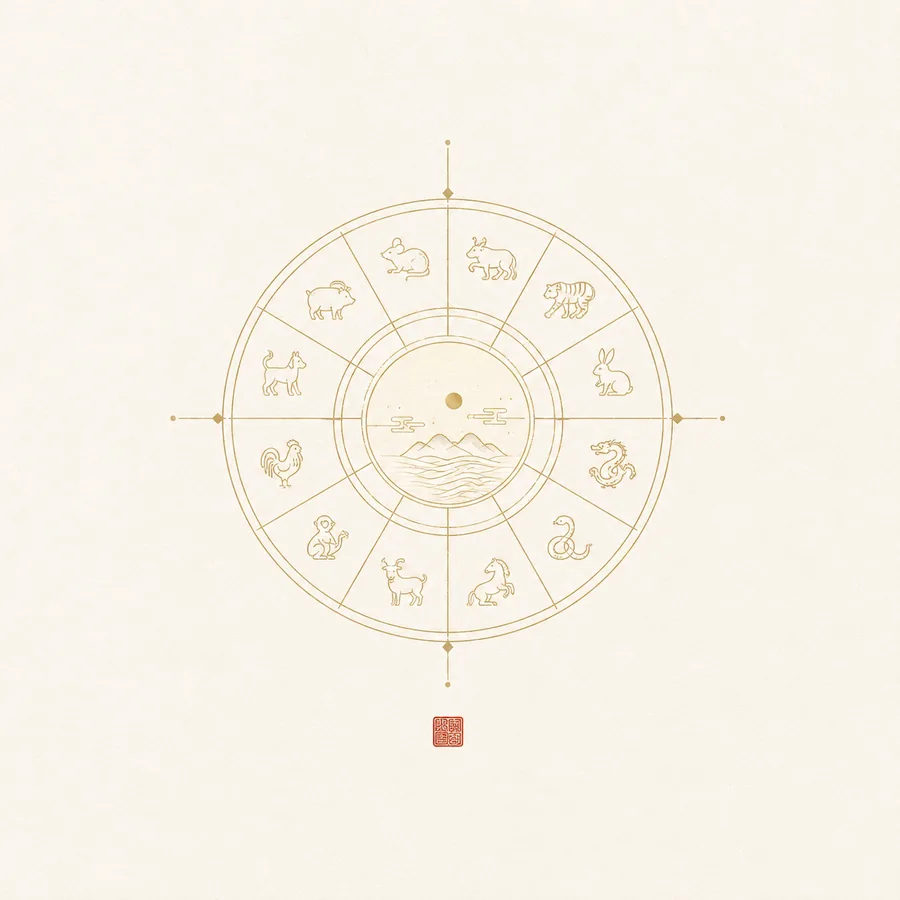
The Two Different Start Dates (And Why They Exist)
Here's where things get interesting. There are actually two different systems used to determine when the Korean zodiac animal year changes:
1. The Lunar Calendar System (used in popular culture) 2. Seollip (입춘 Ipchun) (used in traditional Saju / Four Pillars of Destiny)
Most online zodiac quizzes use the Lunar New Year date, which falls sometime between late January and mid-February. This is what most people know. But traditional Korean Saju practitioners? We use Ipchun, which is the solar term marking the beginning of spring.
These two dates can be weeks apart, which means two people born around the same time could get completely different animal signs depending on which system is applied.
What Is Ipchun (입춘) and Why Does Saju Use It?
Ipchun literally means "Start of Spring." It's one of the 24 solar terms (절기 Jeolgi) in the East Asian calendar system, and it falls around February 4th or 5th every year, sometimes February 3rd. The exact time changes slightly each year based on the sun's position.
In traditional Korean Saju, the year pillar, which is the first of the Four Pillars, changes at Ipchun. Not at midnight on January 1st. Not at Lunar New Year. At the solar moment the sun enters 315 degrees of celestial longitude.
I can't tell you how many readings I've done where someone born in late January or early February came in thinking they were one animal, and the Saju chart told a completely different story. A person born on January 28th, 2024, for example, is technically still in the Year of the Rabbit in Saju terms. Even though most people would say 2024 is the Year of the Dragon. The Saju Dragon year didn't begin until February 4th, 2024.
This isn't a technicality. It actually changes how you read the entire chart.
How This Affects Your Four Pillars Chart
The year pillar (연주 Yeonju) in Saju contains two pieces of information: the Heavenly Stem (천간 Cheongan) and the Earthly Branch (지지 Jiji). The Earthly Branch is what gives you your animal sign. So if your year pillar is wrong, the elemental energy of your chart is misread from the very first column.
But the year pillar isn't even the most important one. Your Day Master (일간 Ilgan), the Heavenly Stem of your Day Pillar, is your core identity in Saju. The animal year you're born in sets broader generational energy, not personal destiny. Still, getting it wrong throws off elemental balance calculations, including your Useful God (용신 Yongsin), which is the element your chart needs most to thrive.
And the month pillar? That one follows its own solar term logic too, which feeds directly into your Grand Fortune (대운 Daeun) periods. But that's a whole other topic.
Korean Zodiac Year Change Dates: A Practical Reference

Here are the Saju (Ipchun-based) year start dates for recent years. Note these are approximate and shift slightly by a day:
| Year | Animal | Saju Year Begins (Approx.) |
|---|---|---|
| 2019 | Pig | Feb 4, 2019 |
| 2020 | Rat | Feb 4, 2020 |
| 2021 | Ox | Feb 3, 2021 |
| 2022 | Tiger | Feb 4, 2022 |
| 2023 | Rabbit | Feb 4, 2023 |
| 2024 | Dragon | Feb 4, 2024 |
| 2025 | Snake | Feb 4, 2025 |
So if you were born between January 1st and around February 3rd or 4th of any given year, you technically carry the animal sign of the PREVIOUS year in Saju.
This is why I always ask clients for their exact birth date AND time before I touch anything else. Even a difference of a few days can shift the entire reading.
The Lunar New Year Confusion
Lunar New Year gets a lot of cultural attention, and rightfully so. It's a huge celebration across Korea, China, Vietnam, and much of the diaspora worldwide. But from a Saju perspective, it's not the trigger for the year pillar change.
The Lunar calendar is lunisolar, meaning it follows the moon but periodically adds intercalary months to stay aligned with the solar year. Lunar New Year drifts around within a roughly 30-day window. Ipchun doesn't. It's solar, anchored to the sun, which is why Saju uses it.
Think of it this way: Lunar New Year is when the cultural celebration happens. Ipchun is when the energetic shift actually occurs. Both are real. They're just serving different purposes.
If you're curious about how your specific birth year affects your relationships and romantic compatibility, a Saju love reading can map out exactly how your animal year interacts with a partner's chart.
What If You Were Born Right on the Cusp?
This is the tricky part. Let's say you were born on February 4th. You might be born before or after Ipchun depending on what time you arrived and what time zone you're in. This is why birth time matters so much in Saju. The exact hour of Ipchun changes by minutes each year.
In my practice, when someone is born within 24 hours of a major solar term change, I look at both possibilities and see which chart resonates more accurately with their lived experience. That's not cutting corners. That's just good practice. Charts are tools, not verdicts.
Why This Actually Matters for Your Reading
Here's the practical takeaway. If you've been walking around thinking you're a Rat because you were born on January 30th, 2020, you are actually an Earth Pig in Saju. The Rat year started February 4th, 2020.
That's not a small difference. The Pig (해 Hae) carries Water element energy. The Rat (자 Ja) also carries Water, but they interact with other pillars in very different ways, including how they clash or harmonize with your Day Master.
Getting the animal year right is the foundation for everything else, including understanding your Grand Fortune (대운) periods and how Annual Fortune (연운) years affect you. The year you're born sets your starting point. The rest of the chart builds from there.
If you want to go deeper on how to actually read a Saju chart yourself, the free Saju ebook breaks down the basics in a way that makes these solar term distinctions make sense.
Frequently Asked Questions
When does the Korean zodiac year start?
In traditional Korean Saju (Four Pillars of Destiny), the animal year starts on Ipchun (입춘), which falls around February 4th each year. This is different from Lunar New Year, which is the more widely known cultural celebration but is not used in Saju for year calculations.
What's the difference between Lunar New Year and Ipchun for the Korean zodiac?
Lunar New Year follows the moon cycle and shifts between late January and mid-February. Ipchun is a fixed solar term that marks the astronomical beginning of spring, around February 4th. Saju uses Ipchun because it follows a solar calendar system based on the sun's position.
If I was born in January, what's my Korean zodiac sign?
If you were born in January, your Korean zodiac animal in Saju is the animal from the PREVIOUS year. For example, someone born January 20th, 2024 is still a Rabbit (2023 year) in Saju terms, not a Dragon. The Dragon year didn't start until February 4th, 2024.
Does the hour of birth affect which animal year you belong to?
For people born very close to Ipchun (February 3rd to 5th), the exact birth time can matter. Ipchun occurs at a specific moment each year, so someone born the same calendar day might be in different animal years depending on the hour. A professional Saju reader will calculate the exact solar term moment for your birth year.
Getting this date question right is genuinely one of the most important first steps in Saju. Everything downstream, from your elemental balance to your fortune periods, rests on having accurate pillar data. If you've been using the wrong animal year, your chart has been telling someone else's story.
Discover Your Destiny
Curious about your own chart?
Get a free mini reading, then unlock your full Four Pillars report from a certified Saju master.