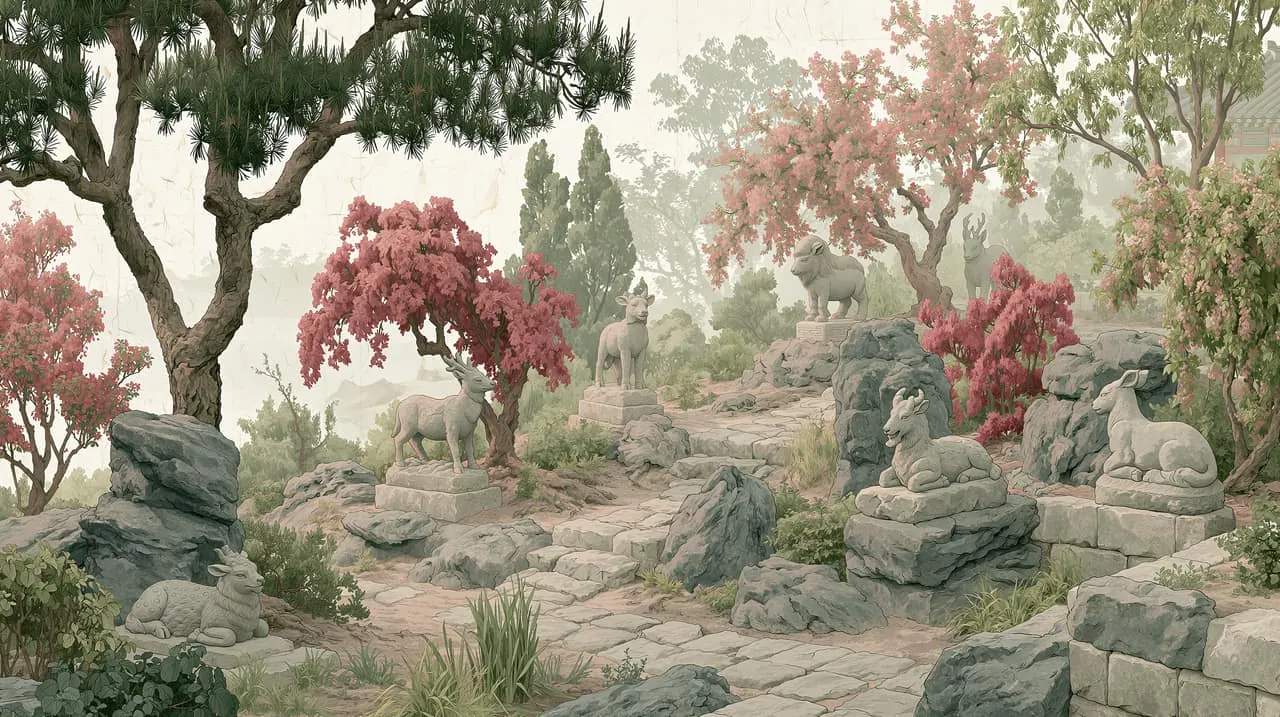
Korean Birth Year Animal: Find Your Ddi in the 12-Sign Chart
Look up your Korean birth year animal (ddi) for any year, plus its element and colour, and check the Ipchun date that decides January births.
Your Korean birth year animal is your ddi (띠), the one of 12 animals attached to the year you were born. When someone in Korea asks "무슨 띠예요?" (what's your ddi?), they want that animal, and it usually takes about two seconds to answer. The catch is that the animal is only half of what your birth year actually carries, and for anyone born in January or early February the answer itself can be wrong.
This page is built as a lookup. Find your year in the chart below, read off your animal, then use the last digit of your year to get the element and colour Koreans pair with it. If you want the whole birth chart rather than just the year, the free saju reading calculates all four pillars from your date and hour in under a minute.
One quick note before the chart. If you arrived here looking for the animal of your birth hour, that is a separate lookup, and it lives in the birth hour animal guide. This page is about the year.
The 12-Sign Korean Birth Year Animal Chart
Each animal is an Earthly Branch (지지, jiji). The branch has its own element, which is fixed and never changes. Find your birth year in the right-hand column.
| Animal | Korean ddi | Branch | Branch element | Birth years |
|---|---|---|---|---|
| Rat | 쥐띠 jwi-tti | 子 ja | Water | 1936, 1948, 1960, 1972, 1984, 1996, 2008, 2020 |
| Ox | 소띠 so-tti | 丑 chuk | Earth | 1937, 1949, 1961, 1973, 1985, 1997, 2009, 2021 |
| Tiger | 호랑이띠 horangi-tti | 寅 in | Wood | 1938, 1950, 1962, 1974, 1986, 1998, 2010, 2022 |
| Rabbit | 토끼띠 tokki-tti | 卯 myo | Wood | 1939, 1951, 1963, 1975, 1987, 1999, 2011, 2023 |
| Dragon | 용띠 yong-tti | 辰 jin | Earth | 1940, 1952, 1964, 1976, 1988, 2000, 2012, 2024 |
| Snake | 뱀띠 baem-tti | 巳 sa | Fire | 1941, 1953, 1965, 1977, 1989, 2001, 2013, 2025 |
| Horse | 말띠 mal-tti | 午 o | Fire | 1942, 1954, 1966, 1978, 1990, 2002, 2014, 2026 |
| Goat | 양띠 yang-tti | 未 mi | Earth | 1943, 1955, 1967, 1979, 1991, 2003, 2015, 2027 |
| Monkey | 원숭이띠 wonsungi-tti | 申 sin | Metal | 1944, 1956, 1968, 1980, 1992, 2004, 2016, 2028 |
| Rooster | 닭띠 dak-tti | 酉 yu | Metal | 1945, 1957, 1969, 1981, 1993, 2005, 2017, 2029 |
| Dog | 개띠 gae-tti | 戌 sul | Earth | 1946, 1958, 1970, 1982, 1994, 2006, 2018, 2030 |
| Pig | 돼지띠 dwaeji-tti | 亥 hae | Water | 1947, 1959, 1971, 1983, 1995, 2007, 2019, 2031 |
Your year isn't on the list? Add or subtract 12 until it lands on one. A 1924 birth, for example, is 1936 minus 12, so Rat.
If you prefer arithmetic, divide the year by 12 and look at the remainder: 0 Monkey, 1 Rooster, 2 Dog, 3 Pig, 4 Rat, 5 Ox, 6 Tiger, 7 Rabbit, 8 Dragon, 9 Snake, 10 Horse, 11 Goat. 2026 divided by 12 leaves 10, so 2026 is a Horse year. 1992 leaves 0, so Monkey.

Find Your Element and Colour From the Last Digit
This is the part most English zodiac charts skip, and it is why you see names like "Water Monkey" or "Black Tiger." Every year also has a Heavenly Stem (천간, cheongan), and the stem is decided entirely by the last digit of the year.
| Last digit of year | Stem element | Yin or Yang | Colour name in Korean |
|---|---|---|---|
| 0 | Metal | Yang | White (백, baek) |
| 1 | Metal | Yin | White (백, baek) |
| 2 | Water | Yang | Black (흑, heuk) |
| 3 | Water | Yin | Black (흑, heuk) |
| 4 | Wood | Yang | Blue (청, cheong) |
| 5 | Wood | Yin | Blue (청, cheong) |
| 6 | Fire | Yang | Red (적, jeok) |
| 7 | Fire | Yin | Red (적, jeok) |
| 8 | Earth | Yang | Yellow (황, hwang) |
| 9 | Earth | Yin | Yellow (황, hwang) |
Put the two lookups together and you have your full year name. A 1992 birth ends in 2, which gives Yang Water, and the animal chart gives Monkey: Water Monkey, or in the Korean colour shorthand, a black monkey (흑원숭이). That colour version is exactly what people mean when they search for the "Korean year of the black monkey." A 1989 birth ends in 9 (Yin Earth) and falls on Snake: Earth Snake, a yellow snake.
Because 10 stems cycle against 12 animals, the same element and animal combination comes back only every 60 years. That is why Koreans make so much of the 60th birthday, which I wrote about in the hwangap guide.
Recent and Upcoming Years at a Glance
Korean news and greeting cards name each new year by colour and animal. Here are the current ones, worked out with the two tables above.
| Year | Stem and branch | Element name | Korean colour name |
|---|---|---|---|
| 2020 | 庚子 | Yang Metal Rat | White Rat |
| 2021 | 辛丑 | Yin Metal Ox | White Ox |
| 2022 | 壬寅 | Yang Water Tiger | Black Tiger |
| 2023 | 癸卯 | Yin Water Rabbit | Black Rabbit |
| 2024 | 甲辰 | Yang Wood Dragon | Blue Dragon |
| 2025 | 乙巳 | Yin Wood Snake | Blue Snake |
| 2026 | 丙午 | Yang Fire Horse | Red Horse |
| 2027 | 丁未 | Yin Fire Goat | Red Goat |
| 2028 | 戊申 | Yang Earth Monkey | Yellow Monkey |
| 2029 | 己酉 | Yin Earth Rooster | Yellow Rooster |
| 2030 | 庚戌 | Yang Metal Dog | White Dog |
| 2031 | 辛亥 | Yin Metal Pig | White Pig |
A small piece of trivia that tests the table: 2007 was heavily promoted in Korea as a rare "golden pig" year. By the stem, 2007 (丁亥) ends in 7, so it is a red Fire Pig. The year whose stem really is yellow Earth is 2019 (己亥), and that is the one later called 황금돼지해 with a better claim to the name.
Two Elements in One Year: Don't Mix Them Up
Here is where readers get confused, and honestly where a lot of online charts are sloppy. A year carries two elements at once:
- The stem element, from the last digit. This is the "Water" in Water Monkey. It changes every two years.
- The branch element, from the animal. Monkey is always Metal, whatever the year.
So a 1992 Water Monkey has Water on top and Metal underneath. In the five-element cycle Metal feeds Water, which makes 壬申 a year pillar where the lower character supports the upper one. Compare 2028, a Yellow Earth Monkey (戊申): Earth on top, Metal below, and this time it is the upper character that feeds the lower one. Same animal, different internal flow. That difference is the whole reason one zodiac animal splits into five different types.
When you see a site list "Monkey = Metal" next to "1992 = Water Monkey," both are right. They are describing different halves of the same pillar. The full branch meanings, including the elements hidden inside each animal, are laid out in the 12 Earthly Branches guide.
The January Problem: When Your Ddi Starts
This is the step that changes real answers. The animal year does not start on 1 January. In everyday Korean conversation, people may count it from the calendar year, from Seollal (the lunar new year) or from Ipchun (입춘, the start of spring, around 4 February). A saju chart uses Ipchun, every time.
Take a hypothetical birth date of 20 January 1990.
- By the calendar year, it looks like 1990, a Horse.
- Seollal in 1990 fell on 27 January, so by the lunar count it is still the 1989 Snake.
- Ipchun in 1990 fell on 4 February, so in saju it is also the Snake: year pillar 己巳, Yin Earth Snake.
Now move that hypothetical date to 1 February 1990. Seollal has passed, so the lunar count says Horse. Ipchun has not, so the saju chart still says Snake. Same person, two different "Korean zodiac" answers depending on which rule the source used.
If you were born between roughly 1 January and 5 February, check the boundary before trusting any chart, including the one above. I explain why saju draws the line at spring in why your saju year changes at Ipchun, and the exact dates are in Korean zodiac dates. The free reading applies the boundary for you automatically.
What the Birth Year Animal Tells You, and What It Doesn't
In saju, your ddi is the branch of your year pillar. That is one character out of eight. Traditionally the year pillar speaks to your roots: family background, the generation you grew up in, and the first impression you make in a group. It is a real part of the chart, but it is shared by everyone born in the same 12 months.
The character that describes you most personally is the Day Master, the stem of your day pillar, which changes every day rather than every year. For the 20 January 1990 example, the full pillars work out as year 己巳, month 丁丑 and day 乙酉, so that chart's Day Master is 乙 Eul, Yin Wood. A Snake-year person with a Yin Wood Day Master reads very differently from a Snake-year person with a Yang Metal one, even though they share a ddi. I go further into this in what your zodiac animal misses that your day pillar catches.
Where the ddi does earn its keep:
- Year-by-year timing. Each new year's branch interacts with your year branch. The three samjae years, for instance, are counted from the birth year animal.
- Your own animal year. When your ddi comes around again every 12 years, the year's branch repeats yours, which I cover in when your animal year comes back.
- Quick compatibility checks, covered next.
Quick Compatibility by Birth Year Animal
Korean families still use ddi pairings as a first filter, the step before a full gunghap. Two patterns are worth knowing.
Three-harmony groups (삼합, samhap). These animals form a combined element together and are traditionally seen as easy company:
- Rat, Dragon, Monkey: Water group
- Tiger, Horse, Dog: Fire group
- Rabbit, Goat, Pig: Wood group
- Ox, Snake, Rooster: Metal group
Direct clashes (충, chung). These pairs sit opposite each other on the 12-branch wheel: Rat and Horse, Ox and Goat, Tiger and Monkey, Rabbit and Rooster, Dragon and Dog, Snake and Pig.
A clash between year animals is not a verdict on a relationship. It mostly describes friction between two people's backgrounds and timing. The pairings that matter more sit between the two Day Masters and day branches, which is why a love reading compares the whole charts rather than the animals. For the ranked version of animal pairs, see Korean zodiac compatibility.
Frequently Asked Questions
How do I find my Korean birth year animal?
Find your birth year in the 12-sign chart above, or divide the year by 12 and match the remainder (0 Monkey, 1 Rooster, 2 Dog, 3 Pig, 4 Rat, 5 Ox, 6 Tiger, 7 Rabbit, 8 Dragon, 9 Snake, 10 Horse, 11 Goat). If you were born in January or early February, check whether your birthday falls before Ipchun, around 4 February. If it does, saju counts you in the previous year's animal.
What is my Korean element by birth year?
Use the last digit of your birth year: 0 or 1 is Metal, 2 or 3 is Water, 4 or 5 is Wood, 6 or 7 is Fire, 8 or 9 is Earth. Even digits are Yang, odd digits are Yin. That gives the element of the year stem. Your personal element in saju, though, is the Day Master, which needs your full birth date.
Is the Korean zodiac the same as the Chinese zodiac?
The 12 animals, their order and the stem and branch system are shared. The differences are in naming and use: Korean has its own animal words (호랑이 for Tiger, 양 for Goat), uses the colour-animal year names heavily, and in saju the year boundary is Ipchun rather than the lunar new year many Chinese zodiac sites use.
What does "black monkey" or "red horse" mean in Korean?
It is the colour form of the year name. The colour comes from the year's stem element: white for Metal, black for Water, blue for Wood, red for Fire and yellow for Earth. 1992 is a black monkey because its stem is Water. 2026 is a red horse because its stem is Fire.
See the Rest of Your Chart
Your birth year animal is the first line of a saju chart, not the last. The other seven characters decide how that animal actually plays out: the month that shapes your working life, the Day Master that describes you, and the hour that rounds out the picture. Start with the free saju reading to see your four pillars, or read the Saju Book if you want to learn to read them yourself.
When you're ready for the full interpretation, with your luck cycles and the years ahead, order a personal saju report.
Discover Your Destiny
Curious about your own chart?
Get a free mini reading, then unlock your full Four Pillars report from a certified Saju master.