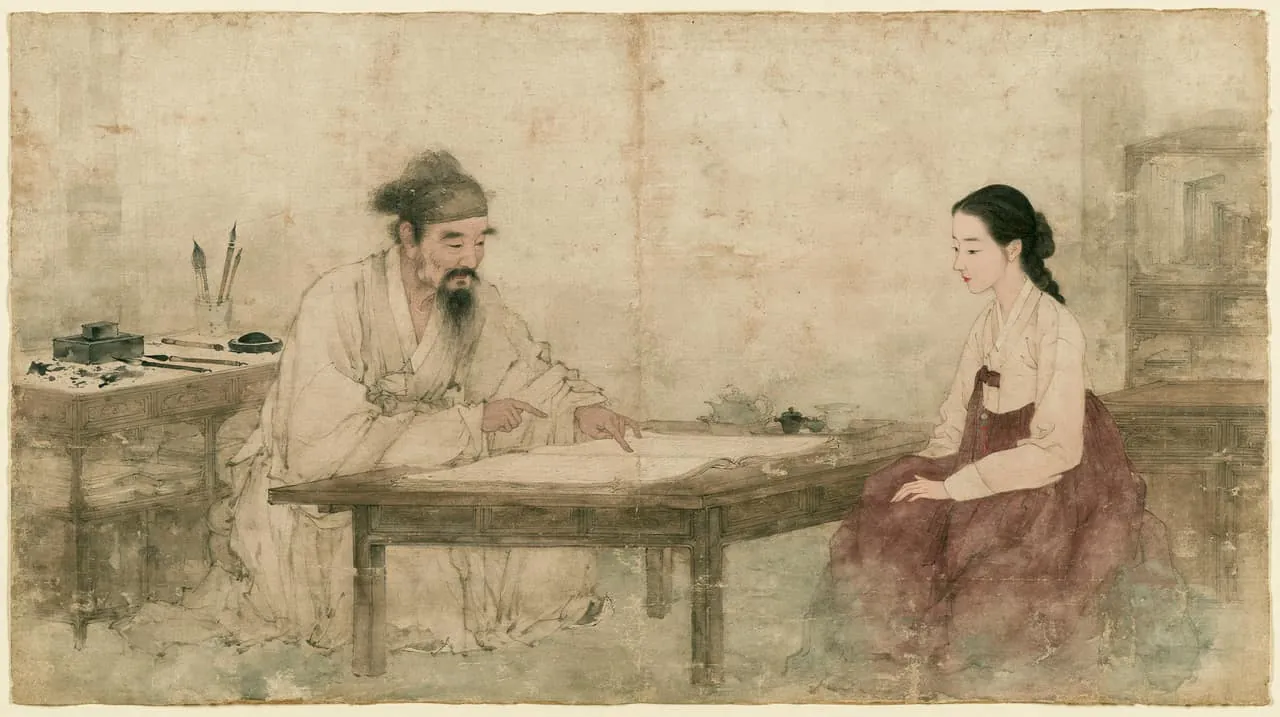
Saju in Korean Workplaces: Hiring Myths and Reality
Is Saju really used in Korean hiring? I break down the myths, real practices, and what your Four Pillars actually say about your career.

Saju in Korean Workplaces: What's Actually Going On Behind the Scenes
If you've ever heard that Korean companies check your birth chart before hiring you, you probably had one of two reactions: "That's wild" or "That makes total sense." Honestly, the truth sits somewhere in between, and after 15 years of doing Saju readings, I've seen both the myth and the reality up close.
Saju (사주), or the Four Pillars of Destiny, is Korea's oldest system of fate analysis. Each person's birth year, month, day, and hour create a unique chart made of Heavenly Stems and Earthly Branches, coded in the Five Elements (오행 Ohaeng). And yes, it absolutely gets used in professional settings. Just not always the way people think. If you want to see how your own chart stacks up before we go further, grab a free reading and follow along.
Let me break this down properly, because there's a lot of noise around this topic and very little signal.

The Myth: Korean HR Departments Run Saju Reports on Every Candidate
This one gets repeated constantly in expat forums and K-drama recaps. The image is some stern HR director cross-referencing a stack of birth charts before approving a job offer. Dramatic. Fun. Mostly not true.
Large Korean corporations, the chaebols and publicly listed firms, do not officially use Saju in their hiring process. They have structured application systems, standardized tests (like the famous GSAT for Samsung or HMAT for Hyundai), and formal interview panels. Saju doesn't appear anywhere in the official paperwork.
But here's the thing. "Official" and "what actually happens" are two different things in any workplace culture.
The Reality: It Happens, Just Not Where You Expect
What I do hear from clients, Korean professionals working in mid-size companies, family-run businesses, and startup environments, is that leadership figures sometimes consult a Saju practitioner privately before making hiring or promotion decisions. Not every time. Not in every company. But often enough that it's not unusual.
A client of mine who works in Seoul's tech sector told me her CEO regularly visits a well-known Saju reader before the annual leadership reshuffle. Not to eliminate candidates, but to understand the "energy dynamics" of potential team configurations. Is this rational by Western HR standards? No. Is it effective according to Saju logic? Actually, yes, in specific ways.
The Four Pillars framework is genuinely useful for assessing compatibility between people's elemental profiles, how someone's Day Master (일간 Ilgan) interacts with a team's dominant energy, whether a specific Grand Fortune period (대운 Daeun) supports someone stepping into a leadership role. These are real analytical tools, not superstition.
What Saju Actually Says About Career Fit

This is where it gets interesting and where most pop-culture coverage completely misses the point.
In Saju, career aptitude isn't determined by your animal year sign. Not even close. The animal year is just one small piece. What matters is your Day Master element, your Ten Gods (십신 Sipsin) configuration, and which elements are in abundance or absent from your chart.
The Ten Gods and Career Archetypes
For example, a chart dominated by the Hurting Officer (상관 Sanggwan) energy tends toward creative disruption. These people are brilliant but anti-establishment. They're terrible fits for rigid corporate hierarchies and excellent fits for startups, investigative roles, or creative agencies. I've seen so many Hurting Officer people stuck in civil service jobs, quietly miserable, because their parents pushed them toward "stability."
On the flip side, someone with a strong Direct Officer (정관 Jeonggwan) influence thrives in structured environments: civil service, corporate law, academia. They respect hierarchy and move up through proper channels. If you put a heavy Direct Officer chart in a chaotic startup with no clear reporting structure, they'll underperform and feel constantly anxious.
The Eating God (식신 Siksin) charts are the ones who genuinely love their craft. Teaching, culinary arts, therapy, design. They produce steadily and sustainably. These folks often get overlooked in competitive hiring because they're not the flashiest interviewers, but they're some of the most reliable long-term employees you'll ever hire.
Timing Matters More Than the Chart Itself
Here's something most non-practitioners don't realize. In Saju, the Grand Fortune (대운 Daeun) period you're currently in matters enormously. Someone might have a strong career chart but be in a destructive 10-year period for their Useful God (용신 Yongsin) element. Taking a major job during that window often leads to setbacks, not because they're unqualified, but because the elemental timing is working against them.
I've had clients who were genuinely talented pass up promotions on my advice because their Daeun timing was off, and they were glad they waited. Two years later, the right opportunity came, the timing aligned, and the transition was smooth.
Saju and Workplace Relationships: The Part Nobody Talks About
Beyond hiring, Saju gets used a lot in Korean workplaces to understand interpersonal dynamics. Will this manager and this team member clash? Will these two co-founders build something together or eventually tear each other apart?
The elemental compatibility logic here is the same as the Productive Cycle (상생) and Controlling Cycle (상극) mechanics used in personal relationships. If a Water Day Master is paired with a Fire-dominant colleague and no bridge elements exist between them, expect friction. It's not inevitable conflict, but it's a pattern I see confirmed regularly.
For workplace relationships that bleed into personal territory, or when you're navigating a work environment that's affecting your love life, a Saju love reading can actually give you clarity on both dimensions at once.
Should Non-Korean Professionals Care About This?
If you're working in Korea, or working closely with Korean companies, at least understanding how this system thinks is genuinely valuable. You don't have to believe in it. But knowing that your Korean counterpart might interpret interpersonal tension through an elemental compatibility lens, or that leadership decisions sometimes get filtered through a Saju reading, gives you real cultural context.
And if you're curious to actually learn the system, not just get a reading but understand the mechanics, the free Saju ebook is a solid starting point. I wrote it specifically for people who want more than a surface-level horoscope and are ready to engage with the real framework.
Frequently Asked Questions
Is it legal for Korean companies to use Saju in hiring decisions?
There's no law explicitly prohibiting the use of Saju in hiring, but Korean labor laws do prohibit discrimination based on personal characteristics. Using birth date information to make formal employment decisions would be legally murky at best. In practice, any Saju influence on hiring tends to be informal and undisclosed.
Which industries in Korea are most likely to use Saju?
From what I've observed, family-run businesses, entertainment agencies, and the wellness and hospitality industries are the most open about it. Some mid-size manufacturing companies with traditional leadership also use it. Large chaebols and foreign-owned firms operating in Korea are the least likely.
Does your birth year animal sign matter for career in Saju?
Less than people think. The animal sign (Earthly Branch of the Year Pillar) is just one of eight characters in your full chart. Your Day Master element and your Ten Gods configuration have far more influence over career compatibility and timing than your zodiac animal.
Can Saju predict whether a job change will be successful?
Not predict in a guarantee sense, but it can identify favorable and unfavorable timing windows based on your Grand Fortune and Annual Fortune (연운 Yeonun) cycles. If your Useful God element is being strengthened in a given period, that's often a green light for bold career moves. If it's being suppressed, patience tends to pay off.
The Bottom Line
Saju in Korean workplaces is real, but it's not the dramatic corporate ritual that viral posts make it out to be. It lives in the informal spaces: a CEO's private consultation, an HR manager's gut feeling backed by someone else's analysis, a team lead trying to understand why two people can't seem to collaborate.
What it gets right, when done properly, is that career success isn't just about skills and timing in the calendar sense. It's about the elemental condition of a person's chart, the Ten Gods they carry, and whether the current Daeun is opening doors or closing them.
If you want to know what your chart actually says about your career trajectory, your ideal professional environment, and your current timing window, I'd recommend getting a proper analysis done.
Discover Your Destiny
Curious about your own chart?
Get a free mini reading, then unlock your full Four Pillars report from a certified Saju master.