Samhap: The Three-Way Combination That Rewrites a Chart
Samhap is one of Saju's most powerful chart mechanics. Three branches unite to transform an element entirely. Here's what that actually means.
Samhap: The Three-Way Combination That Rewrites a Chart
Samhap (삼합) is one of those mechanics in Saju that stops you mid-reading. You're looking at a chart, thinking you understand the elemental balance, and then you notice it: three specific Earthly Branches sitting across the pillars, quietly doing something that changes everything. Not a small tweak. A full elemental transformation.
If you haven't pulled your chart yet, go grab a free reading first. You'll want to know your branches before this clicks into place.
Here's the thing. Samhap isn't just "three branches that get along." It's a complete fusion. The three branches involved stop acting independently and instead become a single, dominant elemental force. That's a fundamentally different idea from most branch interactions, and it's why experienced Saju readers treat it with such respect.
What Samhap Actually Is (And Why It's Not Just a Combination)
In the Four Pillars system, each pillar (year, month, day, hour) carries both a Heavenly Stem and an Earthly Branch. The branches are where a lot of the hidden action happens, and Samhap operates entirely at the branch level.
There are four Samhap groupings:
- Water Samhap: Haesul (해, 묘, 미) | Pig, Rabbit, Goat
- Wood Samhap: Inomyeong (인, 오, 술) | Tiger, Horse, Dog (wait, that's Fire)
Let me redo this properly because this is where a lot of online sources get it wrong.
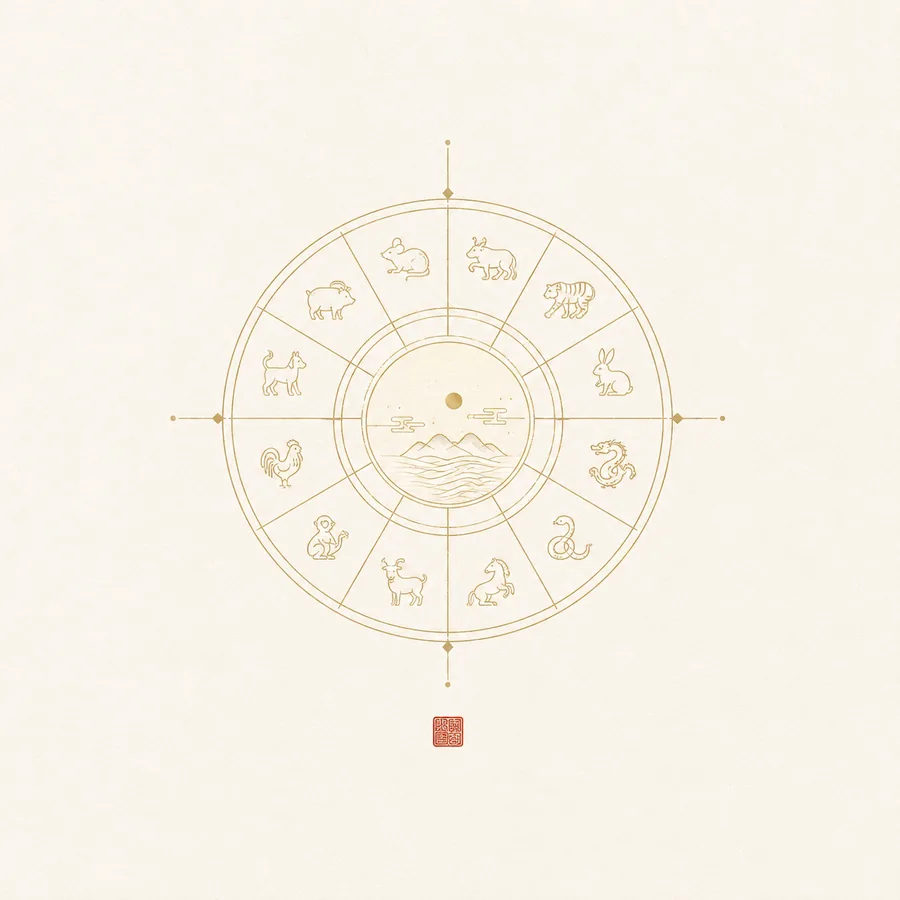
The four Samhap groups are:
- Wood Samhap: Tiger (인 In), Rabbit (묘 Myo), Goat (미 Mi) - these three combine into Wood
- Fire Samhap: Tiger (인 In), Horse (오 O), Dog (술 Sul) - these three combine into Fire
- Metal Samhap: Snake (사 Sa), Rooster (유 Yu), Ox (축 Chuk) - these three combine into Metal
- Water Samhap: Pig (해 Hae), Rat (자 Ja), Dragon (진 Jin) - these three combine into Water
Earth doesn't have a Samhap grouping the same way. Earth is the transitional element, and its branches often play support roles in other combinations.
Each Samhap has what's called a "leader branch" (中氣 / 중기), which is the branch that holds the strongest hidden stem of that resulting element. For Fire Samhap, that's the Horse. For Metal, the Rooster. The other two branches pull toward the leader and the whole trio converts.
Why This Rewrites a Chart
Say someone's chart is balanced, maybe slightly Wood-heavy. Then you notice they have Tiger in the year branch, Horse in the month branch, and Dog in the hour branch. That's a complete Fire Samhap. Three branches that were previously contributing different hidden stems now function as one massive Fire force.
This is where I usually slow down in a reading, because the implication is significant. Wood might have been the Useful God (용신 Yongsin) for this chart, but now you have a Samhap that's burning through Wood to produce Fire at scale. That's the productive cycle doing its thing: Wood feeds Fire. But if Wood was what the chart needed most, losing it to constant Fire production is a problem.
The elemental balance you thought you were reading? Gone. You're working with a different chart now.
And if the Day Master (일간 Ilgan) happens to be a Fire element, Samhap could be pouring so much of the same energy into the chart that it becomes excessive. Strong Day Masters need output, wealth, or authority as a Useful God, not more of themselves flooding in.
Partial Samhap: When Only Two Branches Are Present
This comes up constantly. Not every chart has all three Samhap branches, but two out of three still creates what's called a partial combination (半合 / 반합).
A partial Samhap has some pull but it's incomplete. It creates a tendency, a lean toward that element, rather than a full transformation. Think of it like a fire that's been lit but doesn't have all its fuel yet.
Here's where timing matters. If a Grand Fortune (대운 Daeun) or Annual Fortune (연운 Yeonun) brings in that third branch, the Samhap completes. Suddenly, in that 10-year period or that specific year, the chart tilts dramatically. This is one of the reasons a certain year can feel like an entirely different life phase even if nothing external has obviously changed.
I find partial Samhap really important to track when someone is asking about career shifts or relationship patterns, because the activation of that third branch can trigger major changes in how the chart functions.
Samhap and the Ten Gods: What Element Are You Creating?
This is where it gets nuanced, and honestly, this is one of the most underexplained parts of Samhap in most English-language content.
The element that Samhap produces doesn't exist in a vacuum. It takes on a Ten Gods (십신 Sipsin) identity relative to your Day Master. So if you're a Water Day Master and a Fire Samhap completes in your chart, you've just activated a massive Wealth structure (Water controls Fire, so Fire becomes your Wealth star).
That's different from a Wood Day Master experiencing the same Fire Samhap. For Wood, Fire is the Output star (specifically Eating God or Hurting Officer depending on polarity). Same combination, completely different meaning.
This is why you can't just say "Fire Samhap is good" or "Water Samhap is bad." It entirely depends on who's at the center of the chart, the Day Master, and what that chart actually needs.
For anyone wanting to go deeper into how the Ten Gods work, the free Saju ebook covers the basics in a way that makes this kind of mechanic much easier to follow.
Samhap in Timing: When the Combination Activates
A Samhap sitting fully formed in a birth chart is different from one that gets triggered by fortune cycles. Both matter, but they feel different.
A natal Samhap is structural. It's part of who you are at baseline. You've probably always had that elemental dominance in your personality and approach to life. If you have Water Samhap natally, for instance, there's likely a depth to how you think, a tendency toward withdrawal and reflection, a comfort with complexity that others sometimes find hard to follow.
A Samhap that activates through a Grand Fortune (대운) or Annual Fortune (연운) is more like an event. The chart shifts into that configuration for a defined period, and life often responds accordingly. Career moves, relationship changes, health patterns, all of these can shift when Samhap activates through timing.
The most intense version is when a partial natal Samhap gets completed by a fortune cycle. Two branches have been waiting, and then the third arrives. That year or that decade can be genuinely life-altering.
What Blocks a Samhap
Not all Samhap combinations complete cleanly. There are two main disruptors.
Punishments (형 Hyeong) and Clashes (충 Chung): If one of the three Samhap branches is also in a clash relationship with another branch in the chart, the combination may be disrupted or incomplete. The clash pulls that branch in a different direction before it can fully merge.
Opposing half-combinations: Sometimes a branch is simultaneously being "pulled" into two different combinations. It can't fully commit to either. In these cases, Samhap may only partially activate or switch activation depending on which fortune cycle is dominant.
This is where live chart analysis really matters over any automated system. The interactions between combinations, clashes, punishments, and fortune cycles require a human eye to sort through. If your chart is full of these competing forces, it's worth talking through with someone who knows the system.
Frequently Asked Questions
What is Samhap in Saju?
Samhap (삼합) is a three-branch combination in Korean Four Pillars astrology where three specific Earthly Branches merge to create a single dominant element. Unlike lesser combinations, Samhap can fundamentally transform the elemental balance of an entire chart.
How many Samhap groups are there?
There are four Samhap groups: Wood (Tiger, Rabbit, Goat), Fire (Tiger, Horse, Dog), Metal (Snake, Rooster, Ox), and Water (Pig, Rat, Dragon). Each group combines to produce its corresponding element, which then functions as a Ten God based on the chart's Day Master.
What happens if only two of the three Samhap branches are present?
Having two of three branches creates a partial Samhap (반합), which produces a weaker elemental tendency rather than a full transformation. If the missing third branch arrives via a Grand Fortune or Annual Fortune cycle, the combination can complete and activate during that period.
Does Samhap always benefit the chart?
Not necessarily. Whether a Samhap is helpful or harmful depends entirely on the chart's elemental needs and the Useful God (용신 Yongsin). A Fire Samhap could be wonderful for one Day Master and deeply imbalancing for another. Context is everything in Saju.
Samhap is one of those mechanics where learning it changes how you see every chart you look at afterward. It's not a footnote. It's often the main story.
If you want to know whether Samhap is operating in your chart and what it means for your current fortune cycle, a full reading will map it out for you clearly.
Discover Your Destiny
Curious about your own chart?
Get a free mini reading, then unlock your full Four Pillars report from a certified Saju master.