The Animal of the Day: How Korean Calendars Track Daily Pillars
The animal of the day in Korean calendars comes from the Day Pillar's Earthly Branch. Learn how the 60-day cycle works and why your birth day matters most.
Want this read for your own chart? Ask Master K free or get the full written report · $39
If you've ever flipped through a Korean wall calendar and spotted tiny Chinese characters and animal icons under each date, you've seen the animal of the day. It looks decorative. It isn't. That little animal is the Earthly Branch of the Day Pillar, and it's the backbone of how Korean calendars track daily pillars in Saju, also called Four Pillars of Destiny or Korean astrology.
Here's the part most people never hear: the day you were born has a pillar of its own, and its top half is your Day Master, the core of your whole birth chart. So the animal of the day isn't just a calendar curiosity. It's the same machinery behind your fortune reading. If you want to see what your own Day Pillar says, you can try a free reading before diving deeper.
Let me break down how it all works.
What Is the "Animal of the Day" in Korean Calendars?
Every day on a traditional Korean calendar (만세력, Manseryeok) is assigned two characters. One is a Heavenly Stem (천간), the other an Earthly Branch (지지). Together they form the Day Pillar, or 일주 (Iljyu).
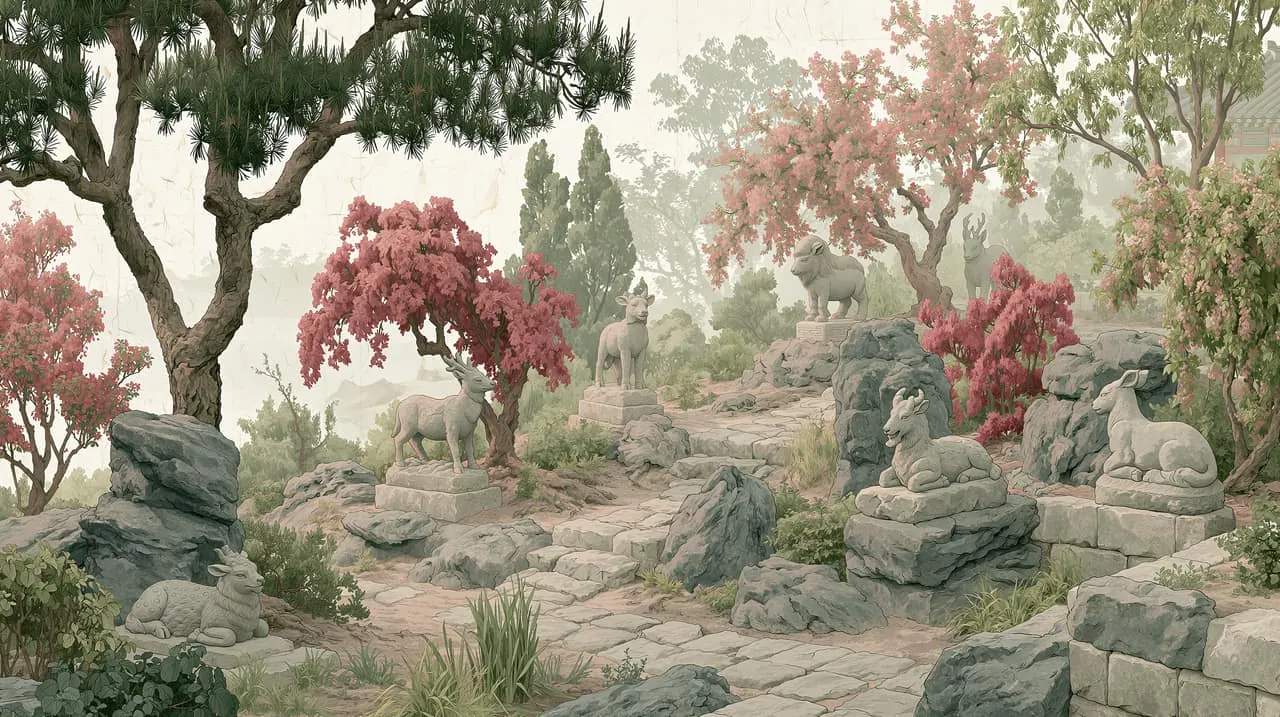
The Earthly Branch is where the animal comes from. The twelve branches map onto the twelve zodiac animals: Rat (자), Ox (축), Tiger (인), Rabbit (묘), Dragon (진), Snake (사), Horse (오), Sheep (미), Monkey (신), Rooster (유), Dog (술), Pig (해).
So when someone says "today is a Tiger day" or "it's a Horse day," they're naming the branch of the Day Pillar. Korean grandmothers in particular love this stuff. Moving house, signing contracts, even cutting hair on certain animal days has a long tradition behind it.
The animal alone is only half the picture, though. The stem rides on top of it.

How Korean Calendars Track Daily Pillars: The 60-Day Cycle
This is the part that surprises people. The days don't follow a 12-day animal loop. They follow a 60-day loop.
Ten Heavenly Stems and twelve Earthly Branches get paired in order, Yang with Yang and Yin with Yin. The pairing runs: Gap-Ja (甲子), Eul-Chuk (乙丑), Byeong-In (丙寅), and so on. Because 10 and 12 share a common factor, you don't get all 120 combinations. You get 60 unique pairs, known as the sexagenary cycle (육십갑자).
Day one is Gap-Ja: Yang Wood over Rat. Day two is Eul-Chuk: Yin Wood over Ox. Keep going for sixty days and you land on Gye-Hae (癸亥), Yin Water over Pig. Then the whole cycle restarts at Gap-Ja.
Think of it like a very old, very elegant odometer. It has been ticking over continuously for thousands of years without skipping a single day. That unbroken count is exactly why a Manseryeok can tell you the Day Pillar for any date in history.
Why the animal repeats every 12 days but the pillar doesn't
The branch cycle is 12 days. So a Tiger day comes around every twelfth day. But the stem cycle is 10 days, so the stem paired with Tiger shifts each time. Tiger might appear as Byeong-In (Yang Fire over Tiger) one round, then Mu-In (Yang Earth over Tiger) the next, and so on. Only after sixty days does the exact same pillar return.
That's why a calendar listing only "Tiger day" is giving you a simplified read. The real flavor comes from stem plus branch together.
How the Day Pillar Is Calculated (and Why You Can't Just Do the Math in Your Head)
Honestly, this is where people get tripped up. The year and month pillars depend on solar terms (절기, Jeolgi), meaning the Sun's position, not the calendar date. The Day Pillar is cleaner. It's a pure running count.
But there's a catch, and it's the one I'd flag for anyone doing this by hand. The new day in Saju doesn't start at midnight in the traditional method. Many practitioners start the day at 11 PM (the beginning of the Rat hour, 자시), while others switch at midnight. This matters if you were born late at night. A baby born at 11:30 PM could land on a different Day Pillar depending on which convention is used.
Time zones and historical daylight saving rules complicate things further. Korea had several time-zone shifts across the 20th century, so a birth time from the 1950s or 60s may need adjusting before the chart is accurate. A good Manseryeok or Saju calculator accounts for all of this. Doing it manually is asking for errors.
Why the Day Pillar Matters More Than the Daily Animal
Here's my honest opinion: the daily animal is the fun entry point, but the real payoff is realizing your own birth day has a Day Pillar, and that's the heart of your chart.
The Heavenly Stem of your Day Pillar is your Day Master (일간, Ilgan). It represents you at the most essential level. If your Day Master is Yang Wood (甲), you're the Towering Tree: principled, ambitious, direct. If it's Yin Water (癸), you're the Rain: intuitive, quiet, spiritually deep.
The Earthly Branch beneath it, the animal, describes your inner environment and, in classical Saju, your spouse palace (배우자궁). That's the position that speaks to long-term partnership and private life. If you're curious how that plays into romance, a Saju love reading looks at exactly this layer.
So say you were born on a Byeong-Ja day. That's Yang Fire over Rat. A Blazing Sun sitting on top of a Water branch. Fire above, Water below, and Water controls Fire. That's a built-in tension, a person who shines outward but may carry a cooler, more complicated interior. It's a hypothetical, but it shows how the daily pillar isn't random decoration. It's the seed of a personality pattern.
Reading Today's Pillar Against Your Own Chart
Now the practical side. Once you know today's Day Pillar from the calendar, you can compare it with your own chart. This is the daily layer of fortune, sitting beneath your annual fortune (연운, Yeonun) and your ten-year Grand Fortune (대운, Daeun).
A few quick things practitioners look for:
- Does today's stem or branch match your Useful God (용신)? If today brings the element your chart needs most, the day tends to feel smoother.
- Does today's element produce or control your Day Master? Take a Yang Wood person on a strong Metal day. Metal cuts Wood, so you may feel pressured or boxed in. On a Water day, Water feeds Wood, so things flow.
- Is there a clash (충) or combination (합) with your birth branches? Rat clashes with Horse, Ox with Sheep, Tiger with Monkey, and so on. A clash day often feels like friction or sudden movement.
I'll be straight with you: daily readings are the lightest layer of Saju. The Grand Fortune and annual energy carry far more weight. Treat the daily animal as weather, not climate. Useful for planning your Tuesday, not for rewriting your life.
Common Misconceptions About Daily Animals
"The animal of the day is the same as my zodiac animal." Not quite. Your zodiac animal in casual Western-style talk is usually your birth-year branch. Saju also has a month animal, a day animal, and an hour animal. The day one is arguably the most personal.
"Lucky animal days guarantee a good day." No. A day is never good or bad in isolation. It's good or bad relative to your chart. A Fire-heavy day that thrills one person can scorch another who already has too much Fire.
"The 60-day cycle is just superstition." It's a remarkably consistent calendrical system, and it's the same cycle used for years, months, and hours. The structure is mathematical even if the interpretation is a matter of belief.
Want to Go Deeper?
If this sparked something, the best next step is understanding the building blocks: stems, branches, the Five Elements, and how they interact. I put together a free Saju ebook that walks through these basics in plain language, no jargon overload.
And if you're someone who tracks your dreams alongside your charts, our Korean dream dictionary pairs nicely with daily-pillar awareness, since Korean tradition links certain symbols to certain days.
Frequently Asked Questions

What is the animal of the day in a Korean calendar?
It's the Earthly Branch of the Day Pillar, one of twelve zodiac animals from Rat to Pig. It repeats every 12 days and is paired with a Heavenly Stem to form the full Day Pillar.
How many days are in the Korean daily pillar cycle?
Sixty. Ten Heavenly Stems and twelve Earthly Branches pair up into 60 unique combinations, called the sexagenary cycle (육십갑자). After day 60, the cycle restarts.
Is the animal of the day the same as my birth-year animal?
No. Your birth-year animal comes from the Year Pillar. The animal of the day comes from the Day Pillar, and your own birth-day animal sits in your chart as a separate, more personal marker.
Why does my Day Pillar change depending on birth time?
Because some Saju traditions start the new day at 11 PM rather than midnight. If you were born between 11 PM and midnight, your Day Pillar may differ depending on the method, so it's worth checking with a reliable calculator.
Your daily animal is just one thread. The full picture comes from your complete chart, with all four pillars, your Day Master, and your timing cycles working together.
Discover Your Destiny
Curious about your own chart?
Get a free mini reading, then unlock your full Four Pillars report from a certified Saju master.