The Twelve Animal Guardians Carved Around Korean Royal Tombs
The twelve animal guardians carved around Korean royal tombs map onto the Earthly Branches of Saju. Here's what the zodiac statues really mean.
Want this read for your own chart? Ask Master K free or get the full written report · $39
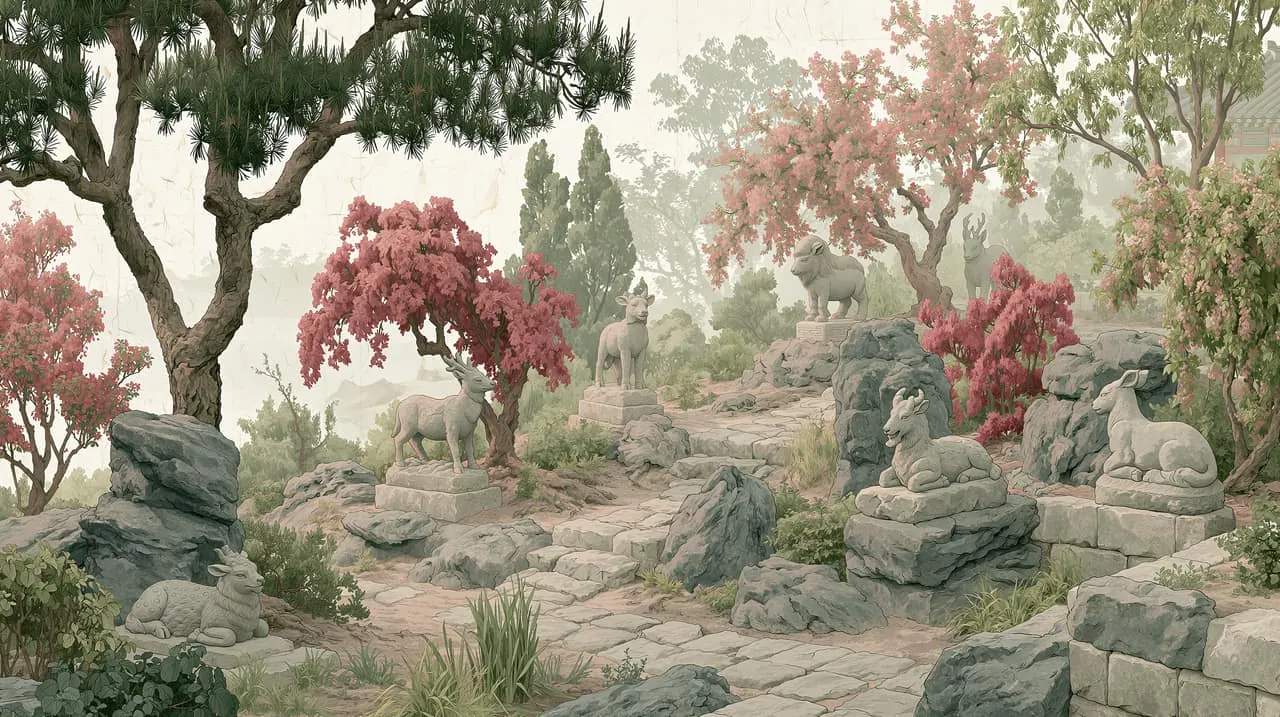
Walk through any Joseon royal tomb outside Seoul and you'll eventually notice something strange. Around the burial mound, the stone figures aren't just generic lions or soldiers. On certain tombs, especially older Unified Silla ones, the twelve animal guardians carved around Korean royal tombs form a full zodiac circle, each beast facing a precise compass direction. It looks decorative. It isn't. It's a map of time and space, and it's the same map I use every day when I read an Earthly Branch in a birth chart.
If you've ever wondered why your birth year gets an animal, this is the oldest visual answer I know. (And if you want to see how your own animal sits in your chart, you can run a free reading first and come back with context.)
What Are the Twelve Animal Guardians of Korean Royal Tombs?
They're called the Sibi-sin (십이지신, 十二支神), the twelve zodiac deities. Each one represents an Earthly Branch (지지, Jiji): Rat, Ox, Tiger, Rabbit, Dragon, Snake, Horse, Goat, Monkey, Rooster, Dog, Pig.
The most famous example is the tomb of King Seongdeok in Gyeongju, plus the tomb of General Kim Yu-sin nearby. The animals appear as relief carvings on the base stones surrounding the mound. Later, in the Joseon period, many were reduced to simple stone figures, but the Unified Silla versions are the real showstoppers.
Here's the detail that always gets me. The animals aren't shown as cute zodiac mascots. Many are carved as human bodies with animal heads, wearing armor, holding weapons. They look like soldiers. Because that's exactly what they were: a spiritual garrison.

Why Guard a Tomb With the Zodiac?
Short answer: protection and orientation.
In the old Korean worldview, a tomb was a house for the dead, and a house needs guards. But a zodiac guard wasn't random muscle. The twelve branches divide the compass into twelve equal 30-degree sectors. Put a Rat at north, a Horse at south, a Rabbit at east, a Rooster at west, and you've built a complete protective perimeter.
This ties directly into Saju logic. The branches aren't just animals, they're positions in a cycle of seasonal energy. Rat is the deep midwinter, the seed of the year. Horse is peak summer. The tomb carvers were essentially building a clock made of stone, with the deceased at the center, held in balance among all twelve phases of Qi.
The Compass Layout (And Why It Matters)
Let me break down the directions, because this is where it clicks for Saju students.
- North: Rat (Water, midwinter)
- Northeast: Ox and Tiger (Earth and Wood, the winter-to-spring hinge)
- East: Rabbit (Wood, peak spring)
- Southeast: Dragon and Snake (Earth and Fire)
- South: Horse (Fire, peak summer)
- Southwest: Goat and Monkey (Earth and Metal)
- West: Rooster (Metal, peak autumn)
- Northwest: Dog and Pig (Earth and Water)
Notice the pattern? The four cardinal animals (Rat, Rabbit, Horse, Rooster) are the "pure" elements: Water, Wood, Fire, Metal. The in-between branches carry the transitions, and four of them (Ox, Dragon, Goat, Dog) are Earth, the stabilizers sitting at each season change.
That's the Five Elements (오행, Ohaeng) rendered as architecture. Wood rises in the east, Fire radiates in the south, Metal condenses in the west, Water sinks in the north, and Earth settles at the seams. Honestly, when I first understood this layout, the whole branch system stopped feeling abstract. It's literally a circle you could walk around.
From Tomb Guardian to Birth Chart Animal
So how does a stone soldier become the animal on your birth year?
Same twelve, different use. In Saju (Four Pillars of Destiny), every pillar has an Earthly Branch. Your Year Pillar branch is your "zodiac animal" in the popular sense. But a real Korean astrology reading looks at all four: year, month, day, and hour branches.
Here's something people miss. The animal guardians weren't assigned by birth year at the tomb. They stood for time itself, each ruling a two-hour slice of the day and a month of the year. That's exactly how the branches work in your chart:
- Rat: 11pm to 1am, 11th lunar month
- Ox: 1am to 3am
- Tiger: 3am to 5am
- Rabbit: 5am to 7am
- Dragon: 7am to 9am
- Snake: 9am to 11am
- Horse: 11am to 1pm
- Goat: 1pm to 3pm
- Monkey: 3pm to 5pm
- Rooster: 5pm to 7pm
- Dog: 7pm to 9pm
- Pig: 9pm to 11pm
If you've been wanting to go deeper on how these pillars stack together, my free Saju ebook walks through it step by step.
Why Some Guardians Hold Weapons and Some Don't
This is one of those details that makes the carvings feel alive. On the Silla tombs, certain animals wear full armor and grip swords or spears. Others stand with open hands, dressed in flowing robes.
I read this as an elemental signature, though I'll admit it's interpretation rather than documented intent. The warrior-style figures tend to land on branches with Metal or sharp Fire energy, Monkey, Rooster, Tiger, Horse. The robed, calmer figures sit with softer Water and Earth branches like Pig, Rat, Ox. Whether the original sculptors thought in those terms, I can't prove. But the pattern fits how these branches behave in a chart. A Rooster branch really is the one that cuts, edits, and defends. A Pig branch really is the one that absorbs and shelters.
The Hidden Seasons Inside the Statues
Here's where the carvings get genuinely clever. Remember the Earth branches? Ox, Dragon, Goat, and Dog.
In the tomb layout they sit at the four "corners" of the compass, between the cardinal animals. In a Saju chart, these are the storage branches (고지, Goji), the places where leftover elemental energy gets stored as one season hands off to the next. Dragon holds Water residue as spring ends. Goat holds Wood residue as summer ends. Dog holds Fire residue as autumn ends. Ox holds Metal residue as winter ends.
So a tomb guarded by all twelve isn't just protected from the four directions. It's protected through every handoff, every transition where energy is most vulnerable. That's the logic, and it's gorgeous. Transitions are where charts get shaky too, which is why Grand Fortune (대운, Daeun) changes tend to feel turbulent even when the new period is good.
Reading Your Own Animal Through the Guardian Lens
Okay, practical part. Say you're born under the Tiger branch. Standing at the northeast corner, between winter and spring, Tiger is the first stirring of Wood coming up out of frozen ground. As a guardian, it's the one who announces the new season. In a chart, a Tiger branch often reads as someone who starts things, who moves first, who can't stand being held back.
Now take a chart with a Goat branch in the day position. Goat sits at the southwest, guarding the late-summer transition. It carries Earth and a hidden trace of Wood and Fire. People with this tend toward quiet warmth, artistic sensitivity, and a stubborn streak they don't advertise. The guardian image helps here: a Goat soldier in robes, not armor.
If you're curious how these animals interact when two charts meet, that's a whole other layer. Branch clashes, combinations, and harms decide a lot of romantic chemistry, and I cover those in my Saju love reading.
Where to See These Guardians in Person
If you're ever in Korea, Gyeongju is the place. The Silla royal tombs there preserve the best zodiac reliefs, and the countryside around the Tumuli Park is oddly peaceful. Stand in front of the carved base stones, find the Rat, then trace the circle clockwise. You'll feel the year turning.
The National Museum of Korea also displays zodiac figurines that once stood inside tomb chambers, tiny clay versions of the same twelve. They're small, strange, and honestly a little unnerving in the best way.
Frequently Asked Questions
What are the twelve animal guardians on Korean royal tombs?
They're the Sibi-sin (십이지신), twelve zodiac figures representing the Earthly Branches: Rat, Ox, Tiger, Rabbit, Dragon, Snake, Horse, Goat, Monkey, Rooster, Dog, and Pig. They're carved around royal burial mounds, most famously in Unified Silla-era tombs in Gyeongju, to protect the dead and orient the tomb to time and direction.
Why do the tomb guardians use zodiac animals instead of other creatures?
Because the twelve branches map onto both the compass and the calendar. Using all twelve created a complete protective circle covering every direction and every phase of seasonal energy, not just a few. It's the same twelve-part system used in Saju birth chart analysis.
Do the tomb animals relate to my Korean zodiac sign?
Yes, they're the same twelve animals. Your birth year branch is one of them. But in a full Four Pillars reading, you also have branches in your month, day, and hour pillars, so your chart actually contains up to four of these guardians working together.
Are the guardian animals shown as animals or as people?
Often a mix. Many Silla carvings show human bodies with animal heads, wearing armor or robes. Joseon-era tombs more often use plain animal figures. The human-bodied style reads as a spiritual guard force rather than a literal menagerie.
If this made your own animal feel less like a cartoon and more like a post you've been standing guard at your whole life, the next step is seeing all four of your pillars together. Get your full Saju report →
Discover Your Destiny
Curious about your own chart?
Get a free mini reading, then unlock your full Four Pillars report from a certified Saju master.