Saju Korean Fortune Telling Explained: What It Really Is
Curious about Saju Korean fortune telling? Here's a clear, honest breakdown of how it works, what your chart reveals, and why it's not just astrology.
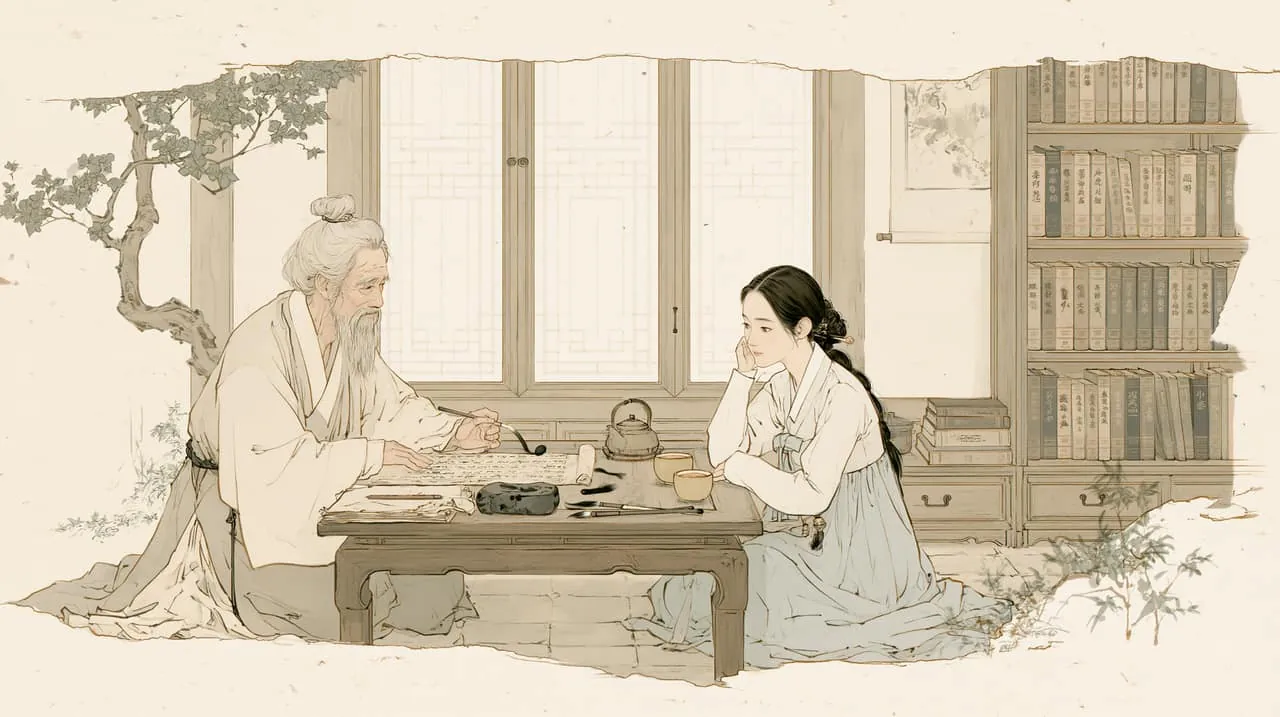
Saju Korean Fortune Telling Explained: What It Actually Tells You
Saju Korean fortune telling is one of the oldest and most precise systems for reading a person's life path, and yet most people in the West have barely heard of it. If you've stumbled across the term through K-dramas, TikTok, or a Korean friend who swears by it, you're in the right place. I've been doing Saju readings for over 15 years, and I still get asked the same basic question almost every day: "What even is this thing?"
Let me give you the real answer, not the watered-down version.
Start by grabbing your Saju reading so you can follow along as we go. Having your actual chart in front of you makes everything click much faster.

The Four Pillars: Your Birth Blueprint
Saju literally means "Four Pillars." Your birth date and time are broken into four columns: Year, Month, Day, and Hour. Each pillar has two parts, a Heavenly Stem on top and an Earthly Branch below. That gives you eight characters total, which is why Saju is also called 八字 (Paljja in Korean), meaning "Eight Characters."
Each of these eight characters carries one of the Five Elements: Wood (목), Fire (화), Earth (토), Metal (금), or Water (수). These aren't just symbols. In Saju, elements move. They produce each other, control each other, and drain each other in specific patterns.
Here's what that looks like in practice. Water feeds Wood (rain grows roots). Wood fuels Fire. Fire creates Earth (ash becomes soil). Earth holds Metal. Metal gathers Water. That's the productive cycle. But cut against the grain and you get conflict: Metal cuts Wood, Water drowns Fire, Earth blocks Water. Every chart is a living map of these tensions and harmonies.
Your Day Master: The Core of Who You Are
Out of all eight characters, the most important one is the Heavenly Stem of your Day Pillar. In Korean, this is called the 일간 (Ilgan), or Day Master. Think of it as your elemental identity, the lens through which your entire chart is interpreted.
Every other element in your chart is read in relation to your Day Master. Are they supporting you or draining you? Are they feeding your strengths or creating friction?
I've sat with thousands of charts over the years, and honestly, the moment I identify someone's Day Master, I already have a rough sketch of their personality, their stress patterns, and the kinds of life situations that push their buttons. It's not magic. It's pattern recognition built into a very precise system.
How Fortune Timing Actually Works in Saju
This is where Saju Korean fortune telling really separates itself from Western astrology. It's not just about who you are. It's about when things happen.
There are two timing layers every reader works with.
Grand Fortune (대운 Daeun) covers 10-year periods. Each decade brings a new elemental energy that overlays your birth chart. Think of it as the climate of your life for that period. If the incoming element is your Useful God (용신 Yongsin), the element your chart is missing and needs most, that decade tends to bring real growth, opportunity, and breakthroughs. If it's a conflicting element, that period comes with friction, delays, and lessons that aren't exactly fun.
Annual Fortune (연운 Yeonun) is the year-by-year weather inside that climate. A great decade with one rough year? You'll feel the bump but recover fast. A hard decade with a hard year stacked on top? That's when patience becomes the most important skill you have.
I use this analogy with clients all the time: Grand Fortune is like whether you're in winter or summer. Annual Fortune is whether it rained today. Both matter, but the season sets the tone.
What Makes Saju Different from Tarot or Western Astrology
People often ask me how Saju compares to other systems. Here's the honest take.
Western astrology is based on planetary positions at the time of your birth. Tarot is intuition-driven and symbol-based. Both are valid tools, but they work differently.
Saju is a time-based mathematical system rooted in the Chinese sexagenary calendar. There are no planets, no cards, no intuitive leaps required. Every reading comes from the same fixed framework: your exact birth data, the Five Elements, and the precise interactions between them. Two trained practitioners reading the same chart should reach similar conclusions about timing, personality, and major life themes.
That consistency is part of why Saju has survived as a serious tradition for over a thousand years. If you're interested in going deeper into how the mechanics work, the free Saju ebook is a solid place to start.
What Saju Can (and Can't) Tell You
Let me be straight with you here.
Saju can reveal your elemental strengths and weaknesses. It can show you which areas of life tend to be smoother (career, relationships, wealth, health) and which require more work. It can pinpoint which years and decades are likely to be transformative, either in a good way or a hard way. It can describe the type of partner who complements your energy, or the kind of work environment where you'd naturally thrive.
What it can't do is tell you exactly what's going to happen on a specific Tuesday. Saju shows tendencies, conditions, and timing windows. It's less like a GPS and more like a really detailed weather forecast. The forecast tells you to bring an umbrella. What you do with that information is still on you.
Relationships are one of the areas where I see Saju used most powerfully. If you're curious about compatibility or romantic timing, a Saju love reading digs into exactly that.
Why Saju Is Having a Moment Right Now
K-pop, K-dramas, and Korean culture broadly have exploded globally over the last decade. With that wave came a genuine curiosity about Korean traditions, and Saju is one of the more fascinating ones.
But here's what surprises people: once they actually sit with a Saju reading, it's not the cultural novelty that hooks them. It's the accuracy. The specificity. The feeling that someone has named something true about their life without them having said a word.
I've had clients come in skeptical (which is fine, honestly healthy) and leave quietly rearranging their assumptions about the world. That shift doesn't happen because Saju is mysterious. It happens because it's precise.
Frequently Asked Questions
What does Saju actually mean in Korean?
Saju (사주) literally translates to "Four Pillars." It refers to the four columns representing year, month, day, and hour of birth. Each pillar contains two characters, giving you eight total, which is why the system is also called Paljja (八字), meaning "Eight Characters."
Do I need to know my exact birth time for a Saju reading?
Ideally yes. The Hour Pillar, your fourth column, depends on your birth time. Without it, a reader can still work with three pillars and get meaningful results, but the reading loses some depth, particularly around career specifics and later life patterns. If you don't know your birth time, some practitioners use a rectification process to narrow it down.
Is Saju the same as Chinese BaZi?
They share the same root system. BaZi is the Chinese term, Saju is the Korean adaptation. Over centuries, Korean practitioners developed their own interpretive traditions, emphasis on certain elements, and regional nuances. So while the foundation is the same, a Korean Saju reading can feel noticeably different in approach and focus from a Chinese BaZi reading.
How often should I get a Saju reading?
Most people find it useful to get a detailed reading once (to understand the whole chart) and then annual check-ins as new yearly energies shift. Big life transitions, a career change, a relationship decision, a move, are also great moments to revisit your chart with fresh timing context.
Saju Korean fortune telling isn't a trend. It's a system that's been tested across millions of lives over centuries. The reason it keeps showing up, from traditional Korean households to TikTok feeds to this article you're reading right now, is because it keeps being useful.
If you're ready to see what your own chart actually says, start here.
Discover Your Destiny
Curious about your own chart?
Get a free mini reading, then unlock your full Four Pillars report from a certified Saju master.