The Long Season of Earning
On wealth luck and career direction, and why prosperity so often keeps a slower calendar than effort does.

From the editor
Most of the questions that reach this desk about money arrive wearing the same quiet worry. People have worked hard, often for years, and the reward has not matched the labor. They want to know whether the creative project will hold, whether the new business will steady, whether the move into a different field will finally pay. Underneath the specifics there is one request, which is reassurance that the effort was not wasted and that the money, when it comes, will come.
Saju, the Korean practice of reading a life from the birth moment, does not promise a date for abundance. What it offers is closer to a weather reading across seasons, a sense of when a chart tends to gather resources and when it tends to spend them. Wealth luck in this reading is rarely a single event. It is a long pattern, and career is the channel that pattern runs through. This issue is written for the reader who feels financially stuck despite doing the work. The honest message is steady rather than thrilling. Earning has its own season, and the season is often longer than we would like, but it does arrive, and it tends to arrive for the people who stayed ready for it.
Knowing and Not Knowing
Reborn Rich (재벌집 막내아들) builds its entire story on a single granted wish. Its protagonist dies and wakes again inside a wealthy family with full memory of the decades to come, so every investment he makes is a sure thing. The premise is seductive because it names the exact fantasy behind most money questions, which is the wish to know in advance. Misaeng: Incomplete Life (미생) sits at the opposite end of that wish. Jang Geu-rae walks into a trading company without a degree, without connections, and without any view of what the next year holds, and he simply works through the uncertainty one task at a time. Set side by side, the two make a plain point. Reborn Rich shows us that foresight would make wealth easy, which is precisely what reveals how rare foresight is. Misaeng shows the actual condition most careers run under, which is earning while blind, and it treats that condition not as a tragedy but as ordinary and survivable.
Funding Is Not Building
Start-Up (스타트업) is often remembered for its romance and its pitch competitions, but its sharper observation is about the gap between recognition and durability. Money arrives in the show through attention, through investors, through a stage and a prize, and the characters learn that winning the funding is a different skill from keeping the company alive afterward. For the reader asking whether a venture will bring stability, this is the useful distinction. A chart may show a year of visibility, when offers and interest gather, without that same year showing the slower support that carries a business through its second and third winters. Recognition can be real and still not be the same thing as abundance.
Wealth luck is not the day the money appears. It is the long stretch during which you remained the kind of person it could appear for.
The Fifteen-Year Timeline
Itaewon Class (이태원 클라쓰) is unusual among success stories because it refuses to compress time. Park Sae-ro-yi sets his plan young and then lets it run for years, opening one small place, holding to a few fixed principles, and absorbing setbacks without abandoning the direction. The show is honest that his patience costs him, and that long stretches pass with little visible return. This is the reading many anxious questioners most need. A career path can be correct and still be slow, and slowness is not the same as failure. The chart that promises a strong later prosperity often asks for exactly this, a willingness to keep a steady course through the years before the course pays.

On the Scene · Two Patterns from the Reading Room
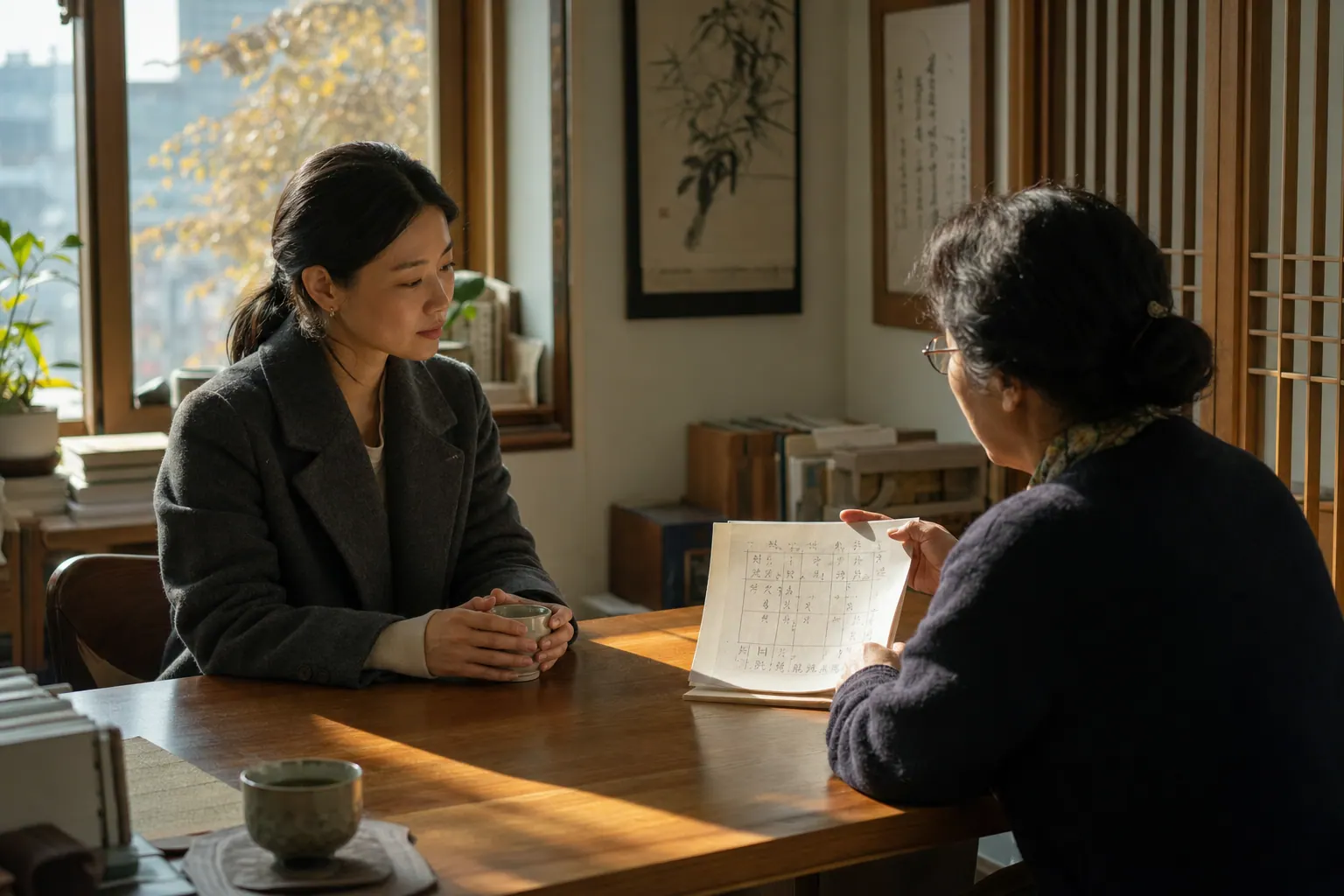
The first pattern arrives more often than any other, roughly one in six readings this season. A person in creative or publishing work, sometimes a writer, sometimes a designer, sometimes someone running a small independent imprint, sits down and describes years of genuine effort that have produced respect but not money. The work is good. People say so. The income does not follow. What the chart usually shows in these cases is not a weak wealth luck but a timing mismatch, a person whose earning channel runs strongest in a later stretch than the one they are standing in. The reassuring part, which I try to deliver slowly so it lands, is that the respect already earned is not separate from the money to come. It is the groundwork the money will stand on. The patient instruction is to stop reading the present shortfall as a verdict, to protect the body and the finances through the lean stretch, and to keep publishing, because the audience being built now is the resource that converts later. These readings end calmer than they begin, because the person usually already suspected the work was sound and only needed to hear that the delay was timing rather than judgment.
The second pattern is the career transition, often a person in their thirties or early forties weighing whether to leave a stable but unrewarding position for a business, an investment path, or a move into a field they care about more. The fear is symmetrical. They are afraid to stay and afraid to leave. In the chart I look for whether the coming years support building or support holding, because the two ask for different temperaments and different amounts of cash in reserve. More often than people expect, the reading does not forbid the leap but adjusts its speed. A year that supports a transition is not always a year that supports an immediate full commitment, and the steadier route is frequently to begin the new path alongside the old income rather than in place of it. I tell these readers that abundance rarely rewards haste and rarely punishes preparation, and that a transition made with one season of savings behind it reads very differently from one made in a rush. The direction they feel pulled toward is usually right. It is the timing and the cushion that the reading can help them set.
If there is one thing to carry out of this issue, let it be that feeling stuck is not the same as being stuck. Wealth luck moves on a longer calendar than a single difficult year, and the effort that feels unrewarded now is very often the deposit that a later season draws on. Stay ready, keep the work honest, and hold some reserve for the turn. If you would like to know where your own earning season sits, and when your chart tends to gather rather than spend, you are welcome to write in for a free reading. We will take it slowly, and we will read it with patience.
If this sounds like you
Read your own timing.
Start with a free mini reading. When you want the full picture, a certified Saju master writes your complete Four Pillars report.